


⚓ The Gosships Team
Gosships Intelligence Is Published At Gosships.com
For Sponsorship And Partnership Inquiries Contact intelligence@gosships.com
|⚓ About Us | 🛢️ Exclusive Report | 📋 SwiftAction Training |
🏅Black Gold Membership (*53 Slots Left)
Three days after a peace deal reopened the Strait of Hormuz, Iran says it just slammed it shut again. On Saturday, June 20, Iran’s Revolutionary Guard Corps declared the world’s most important oil chokepoint closed to all shipping, blaming the United States for breaching the first clause of the war-ending memorandum signed only on June 17. There is one problem with the announcement. The United States says it is not true. US Central Command insists 55 commercial ships sailed straight through the strait on Saturday, carrying more than 17 million barrels of oil. Then Iran’s own Foreign Ministry said the strait was open, contradicting its own military. Every barrel that does or does not move through that channel is a few cents on the gallon you pump, and tonight nobody can say for certain whether it is open. So is it open or not?
📋 In This Issue:
🛢️ The Story
📊 By The Numbers
🔍 Why It Matters
👀 What To Watch
🚨 Gosships Signal
🔔 Not Yet Subscribed? Gosships Intelligence Delivers Oil Shipping Intelligence. Subscribe Here!
📊 Order Our Exclusive Report
→ Global Tanker Market Outlook Q3 2026 Edition
📋 Competency-Based Maritime Training
→ SwiftAction
📌 Gosships Data Card
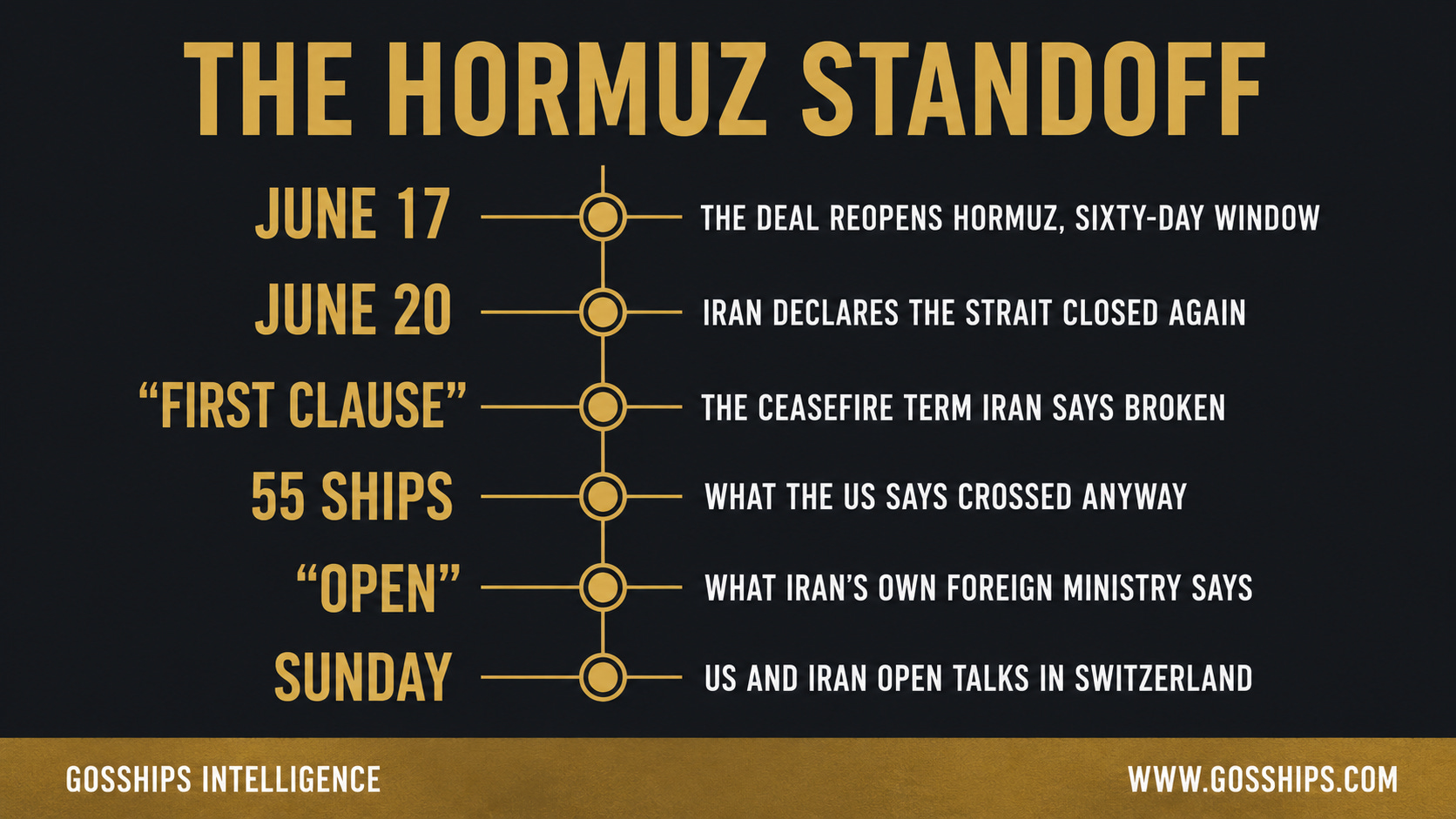
→ JUNE 17 - The deal reopens Hormuz with a sixty-day transit window
→ JUNE 20 - Iran’s IRGC declares the strait closed again
→ “FIRST CLAUSE” - The ceasefire term Iran says the US broke
→ 55 SHIPS - What the US says crossed the strait on Saturday anyway
→ “OPEN” - What Iran’s own Foreign Ministry says
→ SUNDAY - The US and Iran open talks in Switzerland over the deal
Sources: CNN; NPR; CBC; US Central Command (June 20).
🛢️ The Story
For one brief moment, the crisis looked over. On June 17, President Trump and Iranian President Masoud Pezeshkian signed a memorandum of understanding to end the war that began on February 28, a deal that opened a 60-day toll-free window for ships to transit the Strait of Hormuz. Traffic that had been frozen near zero for months began to revive. Kpler tracked more than 20 tankers crossing in a single day, the most since early June, as Iranian-linked vessels switched their transponders back on while leaving the Gulf. Oil prices that had spiked above $120 a barrel during the war settled back down, with Brent closing Friday at $80.57 and West Texas Intermediate at $77.54, according to CNBC. Investors had decided the disruption was finally behind them.
Then, on Saturday, June 20, Iran reopened the wound. Iran’s Revolutionary Guard Corps declared the Strait of Hormuz closed to all vessels, citing what it called “the explicit breach of the first clause of the post-war memorandum of understanding by the United States.” That first clause, according to NPR, required the “immediate and permanent termination of military operations on all fronts, including in Lebanon.” Iran pointed to Israel’s continued strikes on Hezbollah in southern Lebanon, where fighting on Saturday killed at least 16 people in and around the town of Nabatiyeh, as proof the ceasefire had already been broken. In the IRGC’s telling, the agreement that reopened Hormuz is void, and the strait is sealed once more.
Except the United States flatly denies it. US Central Command said shipping through the strait was proceeding normally and that 55 commercial vessels had completed the transit on Saturday, carrying more than 17 million barrels of oil to global markets, according to CBC and CNN. That is not a quiet rebuttal. It is a claim that the strait Iran says is sealed just handled one of its busiest days of traffic since the war began. And then the confusion deepened. Iran’s own Foreign Ministry said the strait was open, directly contradicting the IRGC’s closure announcement, in reporting aggregated by MSN. The result is a single chokepoint carrying three official positions at once. Iran’s military says closed. The United States says open. Iran’s diplomats say open. The market is left to guess which one is real.
The timing is not an accident. Iran’s closure declaration landed on the eve of negotiations that opened Sunday in Switzerland, where US and Iranian teams, mediated by Pakistan and Qatar, sat down to settle the terms of that same memorandum and to discuss oil-sanctions relief and frozen Iranian assets. On the opening day, Vice President JD Vance went further than denial. He declared that “the opening of the Strait of Hormuz” had “already been accomplished” and said the strait had just moved a record volume of oil, more than at any point before the conflict, according to Al Jazeera. Tehran’s negotiators, in the same talks, were arguing the opposite. Declaring Hormuz closed as the negotiations opened hands Iran maximum leverage. The one card it has always held is the ability to choke off a fifth of the world’s oil, and it is laying that card on the table at the very moment the two sides sit down, whether or not a single ship has actually been turned back.
By Sunday, even the talks meant to repair the deal had grown tense. In a Fox News interview, President Trump said he had warned Iranian officials directly not to close the strait, telling them "You close it and you won't have a country," even as Israel's continued strikes on Hezbollah in Lebanon, the fighting Iran cited to justify the closure, hung over the negotiations. Vice President Vance insisted the two sides were still making "great progress." Days after signing a deal to end the war, they could not agree the war was over, could not agree the strait was open, and were trading threats while they talked.
So is anything truly closed? The honest answer tonight is that no one outside the IRGC and CENTCOM can say for certain. Even as the talks opened on Sunday, the split held, with independent trackers showing transits sliding back toward zero while the United States insisted oil was still moving through at record volume. The physical evidence is mixed. Traffic had genuinely been reviving since the June 17 deal, according to Kpler, yet ship operators remained deeply wary after nearly four months of mines, drone attacks and boardings, and more than 500 vessels are still estimated to be waiting to exit the Gulf. A declaration of closure does not need to be enforced with a single shot to do its work. The announcement alone reprices war-risk insurance, unsettles crews, and freezes charterers who cannot gamble a 2-million-barrel cargo and a 25-person crew on a maybe. Iran does not have to sink a tanker to close the strait. It only has to make owners believe it might.
This is not the first time Iran has reached for this lever, which is part of why the market cannot simply dismiss it. On June 11, Iran’s armed forces announced the strait closed to all vessels effective immediately and warned that violators would be targeted, one of several closure declarations that punctuated a war in which Hormuz traffic fell by as much as 95 percent and more than 150 ships piled up at anchor outside the strait. Each time, the announcement did real economic damage before anyone could verify a single interception. Over the course of the war Saudi Arabia diverted crude to its Red Sea port of Yanbu through the East-West pipeline, and the United Arab Emirates routed barrels to Fujairah on the Arabian Sea, bypassing Hormuz entirely, though those workarounds move only a fraction of what the strait carries. The pattern is the point. Iran has learned that the threat by itself is a weapon, and it has deployed it again at the most sensitive possible moment, the night before it sits down to negotiate.
That is why a war of words moves real money. Before the war, about a fifth of the world’s seaborne oil passed through Hormuz. Prices had fallen from their wartime peak above $120 on the belief that the strait was reopening for good. An enforced re-closure would send them straight back up, and the cost would land in fuel, freight and the price of nearly everything that moves. The first place that doubt becomes a number is the insurance market, where war-risk premiums for a single Gulf transit had topped double-digit millions of dollars per voyage at the war’s worst, according to Lloyd’s List, and had only just begun to ease before Saturday’s announcement put them back in play. Whether Saturday’s announcement is the collapse of the ceasefire or a bargaining chip that evaporates the moment the talks begin is the single most important question in the oil market tonight. What it means for tanker rates, for the insurance market, and for anyone with a cargo committed to the Gulf, is below.
📊 By The Numbers
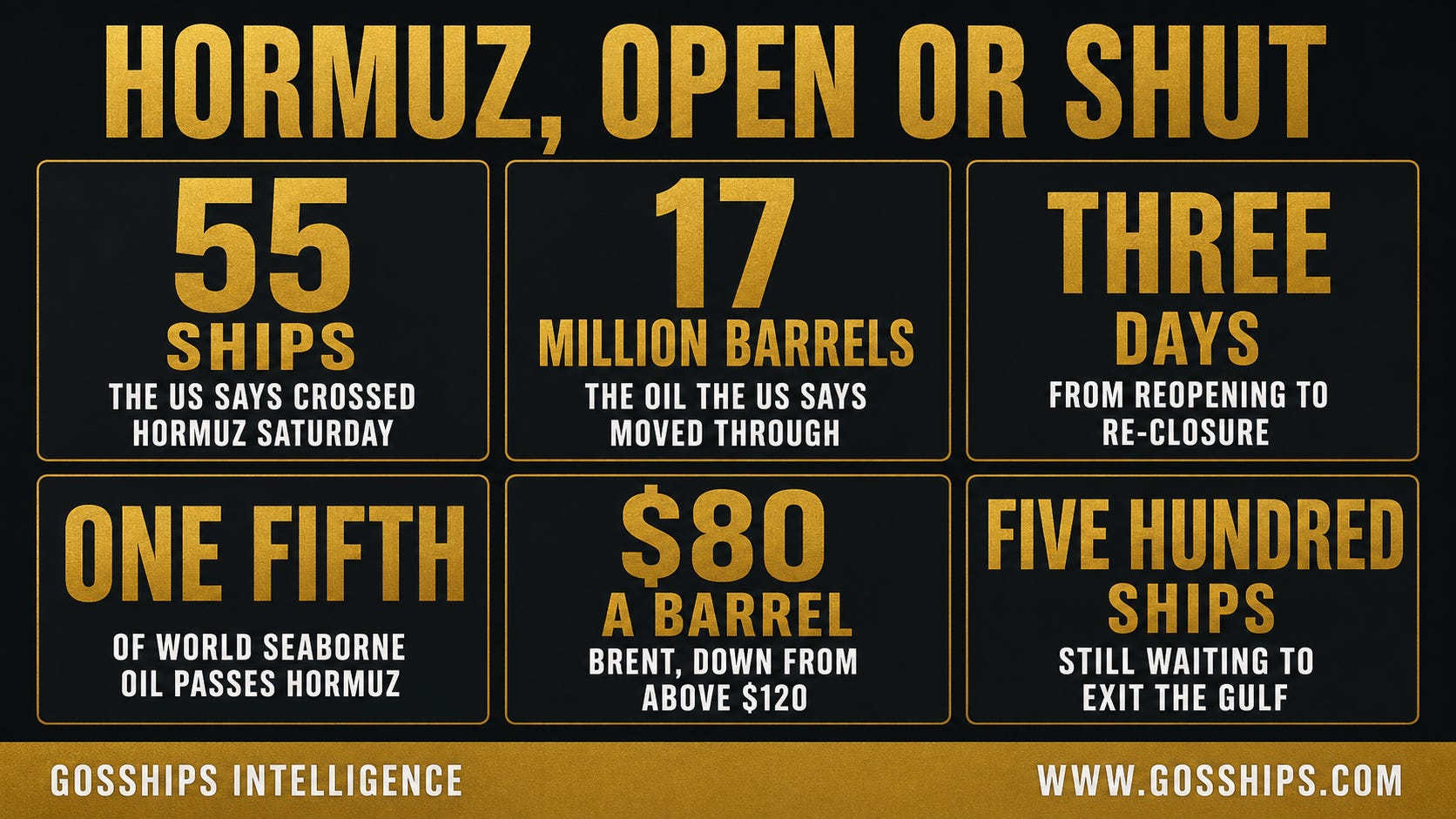
→ 55 ships - What the US says crossed Hormuz on Saturday (US CENTCOM)
→ 17 million barrels - The oil the US says moved through that day (US CENTCOM)
→ 3 days - From the reopening deal to Iran’s re-closure (June 17 to June 20)
→ ~a fifth - Of the world’s seaborne oil that passes Hormuz (EIA)
→ $80.57 - Friday’s Brent close, down from above $120 at the war’s peak (CNBC)
→ 500-plus ships - Still estimated to be waiting to exit the Gulf (Kpler, CNBC)
Sources: US CENTCOM; CNBC; EIA; Kpler.
Related Coverage
Trump Just Ordered Hormuz Open and the Blockade Lifted. Is the Tanker Boom Over?
Hormuz Reopened. China and India Still Can’t Get Their Oil Out. PetroChina Just Rejected Every Tanker Offer It Got.
The US Blockade Crushed Iran’s Oil Exports to a Six-Year Low. Then Trump Signed a Deal at Versailles, and the Tankers Are Already Sailing Again.
🔍 Why It Matters
The headline is a contradiction. The real story is that the most important number in the oil market tonight is not a price, it is a yes or no, and nobody can confirm which it is.
