


⚓ The Gosships Team
Gosships Intelligence Is Published At Gosships.com
For Sponsorship And Partnership Inquiries Contact intelligence@gosships.com
|⚓ About Us | 🛢️ Exclusive Report | 📋 SwiftAction Training |
🏅Black Gold Membership (*53 Slots Left)
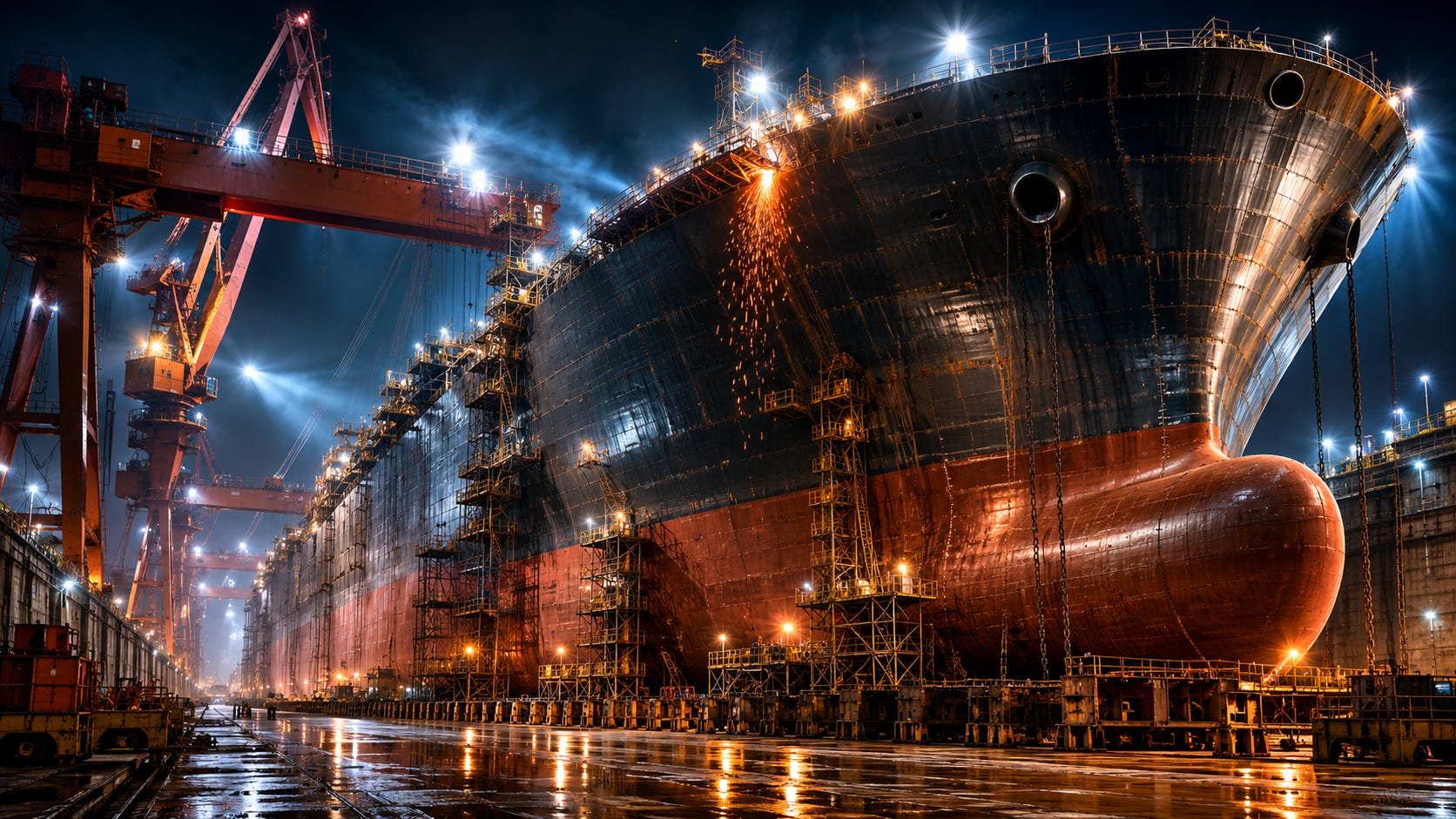
China just won more than nine of every ten new supertankers ordered on Earth this year. Not bought. Not chartered. Built. While the world spent the spring watching the Strait of Hormuz, the same war that froze the strait set off a record stampede to order new VLCCs, and Chinese shipyards captured almost all of it. The country that spent a year hoarding the world’s oil now builds the ships that carry everyone else’s. The supertanker that brings the crude that becomes your gasoline was, more likely than not, ordered from a Chinese yard. Whoever builds the fleet writes the rules for the next twenty-five years of seaborne oil. So is the West already too late to catch up?
📋 In This Issue:
🛢️ The Story
📊 By The Numbers
🔍 Why It Matters
👀 What To Watch
🚨 Gosships Signal
🔔 Not Yet Subscribed? Gosships Intelligence Delivers Oil Shipping Intelligence. Subscribe Here!
📊 Order Our Exclusive Report
→ Global Tanker Market Outlook Q3 2026 Edition
📋 Competency-Based Maritime Training
→ SwiftAction
📌 Gosships Data Card
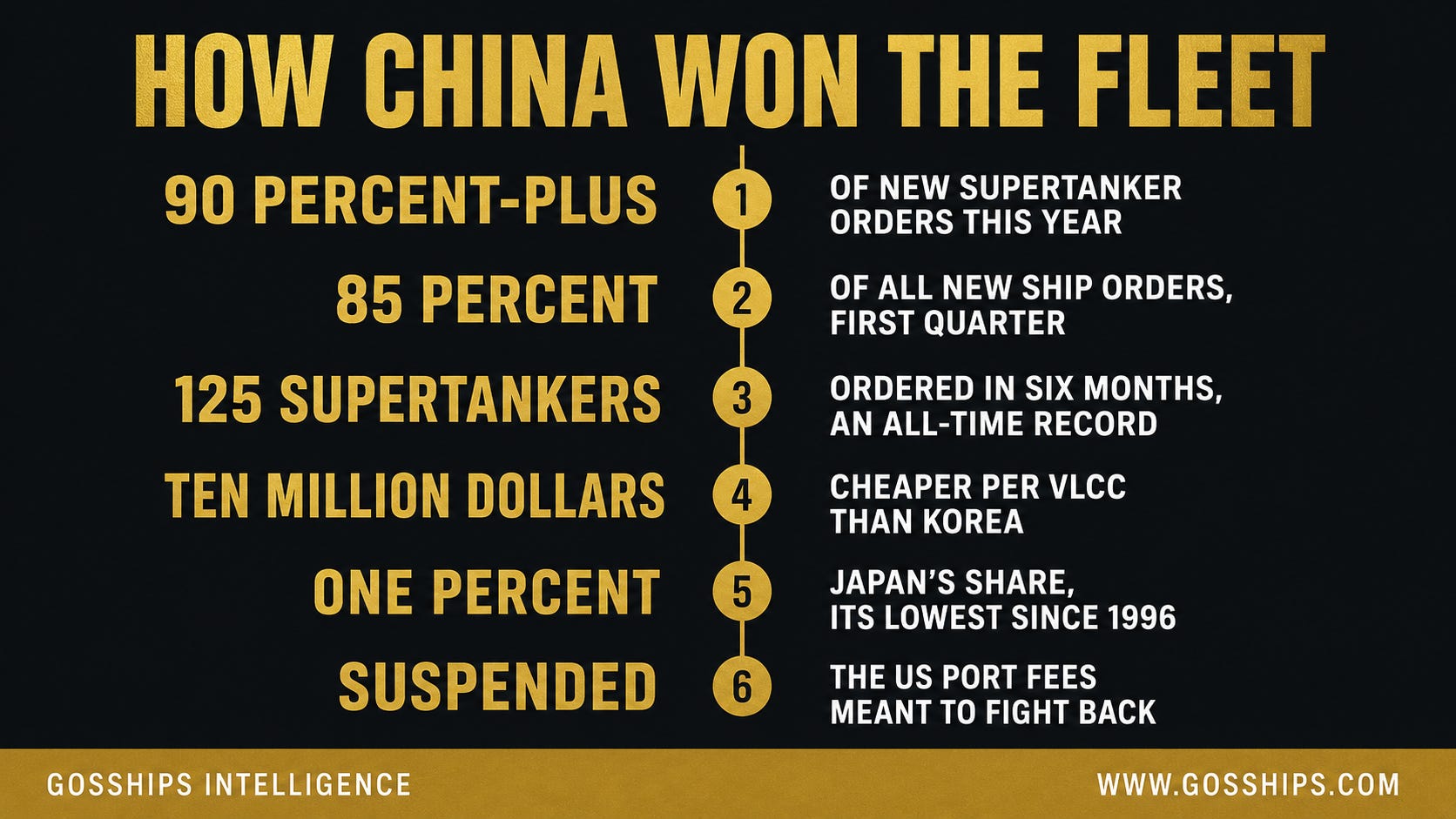
→ 90 PERCENT-PLUS - China’s share of new supertanker orders in 2026
→ ~85 PERCENT - China’s share of all new ship orders in Q1 by tonnage
→ 125 SUPERTANKERS - Ordered in six months, more than any year on record
→ TEN MILLION DOLLARS - How much cheaper a VLCC is to build in China than Korea
→ ~ONE PERCENT - Japan’s share of new orders, its lowest since 1996
→ SUSPENDED - The US port fees on China-built ships, paused until November 2026
Sources: Global Times; BIMCO; Splash247; IndexBox; USTR.
🛢️ The Story
The numbers are not close. In the first quarter of 2026, Chinese shipyards secured 67 of the world’s new VLCCs, roughly 92 percent of all very large crude carrier contracting, according to data compiled by IndexBox, pushing China past 90 percent of global VLCC orders for the year. Across all vessel types, China took 84.9 percent of new orders by deadweight tonnage in the quarter, according to Chinese industry figures reported by Global Times, and around 70 percent measured in compensated gross tonnage, the yardstick BIMCO uses. By either measure no country has dominated shipbuilding like this in living memory. South Korea trailed a distant second, and Japan, once the heart of the industry, fell to roughly 1 percent of new orders, its lowest share since 1996, after contracting at its yards dropped 83 percent year on year, BIMCO reported.
What makes 2026 extraordinary is not just China’s share but the size of the prize it captured. Crude tankers made up about 90 percent of the quarter’s orders, five times the volume placed in the first quarter of 2025, and roughly 125 VLCCs were ordered across the fourth quarter of 2025 and the first quarter of 2026, more than in any full calendar year on record, eclipsing the previous high of 108 set in 2006, according to Splash247. The trigger was the war Gosships has tracked all spring. With the Strait of Hormuz effectively blocked and crude forced onto longer routes around the world, owners needed more ships to move the same oil, and they rushed to order them. The war that made tanker owners rich also handed China the order book.
China wins these orders the way it wins most things, on price and on scale. A VLCC costs roughly 10 million dollars less to build at a Chinese yard than at a South Korean one, a decisive edge when owners are ordering in bulk. Behind that price sits the largest shipbuilding enterprise the world has ever seen. China State Shipbuilding Corporation, which completed its merger with its old rival CSIC in 2025, is now the world’s largest listed shipbuilder, carrying more than 530 vessel orders and around 54 million deadweight tonnes of work, according to Lloyd’s List and company filings. The scale is hard to overstate. The Center for Strategic and International Studies found that in 2024 a single Chinese shipbuilder produced more commercial tonnage than every American yard combined has delivered since the end of the Second World War. CSIS also estimates Chinese shipyards have absorbed about 91 billion dollars in state subsidies, cheap loans and tax breaks since the early 2000s, the foundation of the cost advantage owners now find irresistible.
There is a harder edge to this dominance than price. The same yards that turn out the world’s oil tankers also build the world’s largest navy. China State Shipbuilding Corporation is the prime contractor for the People’s Liberation Army Navy, and the Center for Strategic and International Studies has documented how the flood of commercial orders, the tankers and boxships and bulkers, helps underwrite the workforce, the supply chains and the industrial base that produce warships on the next slipway over. Every VLCC ordered from a Chinese yard is a small contribution to the scale that also turns out frigates and destroyers. For a Western owner it is simply a cheap ship. For Beijing it is a dual-use asset, commercial tonnage and naval capacity built on the same ways, financed in part by the same global shipping industry the West is using to keep its oil away from Russia and Iran.
Washington saw the danger and tried to answer it. In April 2025 the United States Trade Representative, closing a Section 301 investigation into what it called China’s targeting of the maritime, logistics and shipbuilding sectors for dominance, ordered new port fees on Chinese-built ships calling at American ports, even those owned by companies with no link to China. The first fees took effect in October 2025. Beijing retaliated within days, announcing its own special port fees on vessels linked to the United States calling at Chinese ports. And then, almost as quickly, the American measures were switched off, suspended from November 2025 through November 2026 as part of a broader trade truce. So the one weapon the West reached for to slow China’s grip on the fleet is, at the very moment Chinese yards are booking record tanker orders, sitting idle. The fees could return in November. For now, the orders keep flowing east.
The two countries that used to own this industry are taking very different exits. South Korea is retreating upmarket, conceding the high-volume tanker and bulker business to China and concentrating on the high-value ships China still cannot match, the LNG carriers and the naval and specialized tonnage, while betting its future on an alliance with the United States. The trouble is that China is climbing into those segments too, posting record orders for LNG carriers and green, dual-fuel ships in the same quarter, narrowing the high ground Korea has left to hold. Hanwha has bought the Philadelphia shipyard and set up twin hubs in Philadelphia and Busan, HD Hyundai has tied up with a US offshore builder, and Seoul has floated a 150 billion dollar plan it calls Make American Shipyards Great Again to help rebuild the American industry, according to Korean and US trade reporting. Japan has simply faded, its 1 percent share a quiet ending for the country that once launched more ships than anyone alive. The result is a world drifting toward a single supplier for the vessels that move its energy, and a Western answer that is still mostly a plan. Whether that concentration is a commercial fact to manage or a strategic vulnerability to fear, what it means for the owners ordering ships today, for the charterers who will sail China-built tonnage into US ports, and for the regulators deciding whether to switch those port fees back on, is below.
