


⚓ The Gosships Team
Gosships Intelligence Is Published At Gosships.com
For Sponsorship And Partnership Inquiries Contact intelligence@gosships.com
|⚓ About Us | 🛢️ Exclusive Report | 📋 SwiftAction Training |
🏅Black Gold Membership (*53 Slots Left)
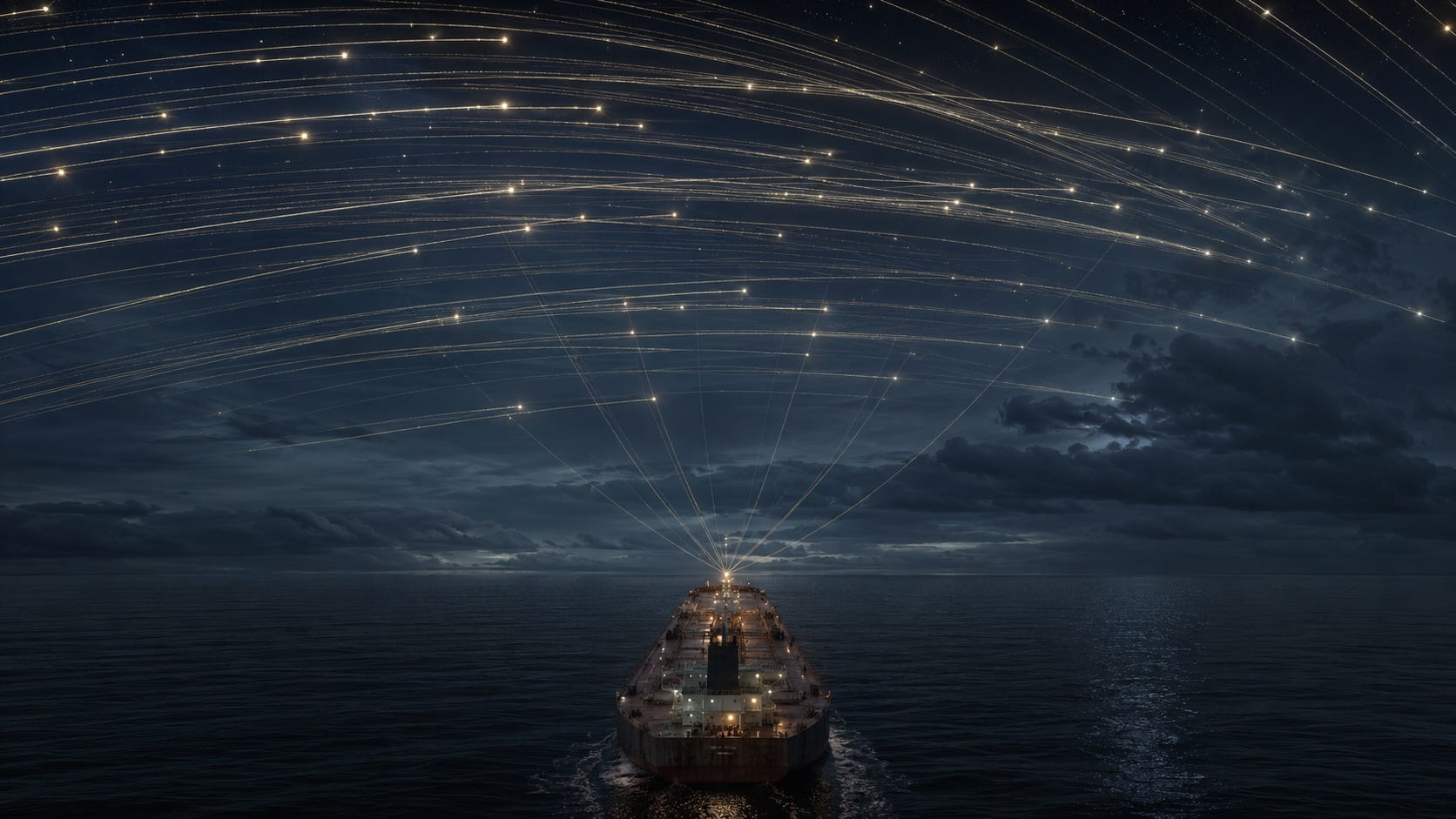
Elon Musk never bought a shipping company. He did something far bigger, and the oil world barely noticed: he became the nervous system of the entire fleet. Of every merchant ship now switching to modern satellite broadband, more than 97 percent connect through his Starlink network, which he built into the dominant link at sea by cutting its price 90 percent and gutting the systems that came before. The crude that becomes the fuel in your tank now moves on ships whose navigation, communications and data run through one man’s satellites. He has already switched that network off once, in a war. And the same constellation quietly keeps Russia’s sanctioned shadow fleet sailing. So the real question is not what would happen if a billionaire bought a shipping line. It is this: what happens the day the one man who controls the fleet’s nervous system decides to switch it off?
📋 In This Issue:
🛢️ The Story
📊 By The Numbers
🔍 Why It Matters
👀 What To Watch
🚨 Gosships Signal
🔔 Not Yet Subscribed? Gosships Intelligence Delivers Oil Shipping Intelligence. Subscribe Here!
📊 Order Our Exclusive Report
→ Global Tanker Market Outlook Q3 2026 Edition
📋 Competency-Based Maritime Training
→ SwiftAction
📌 Gosships Data Card
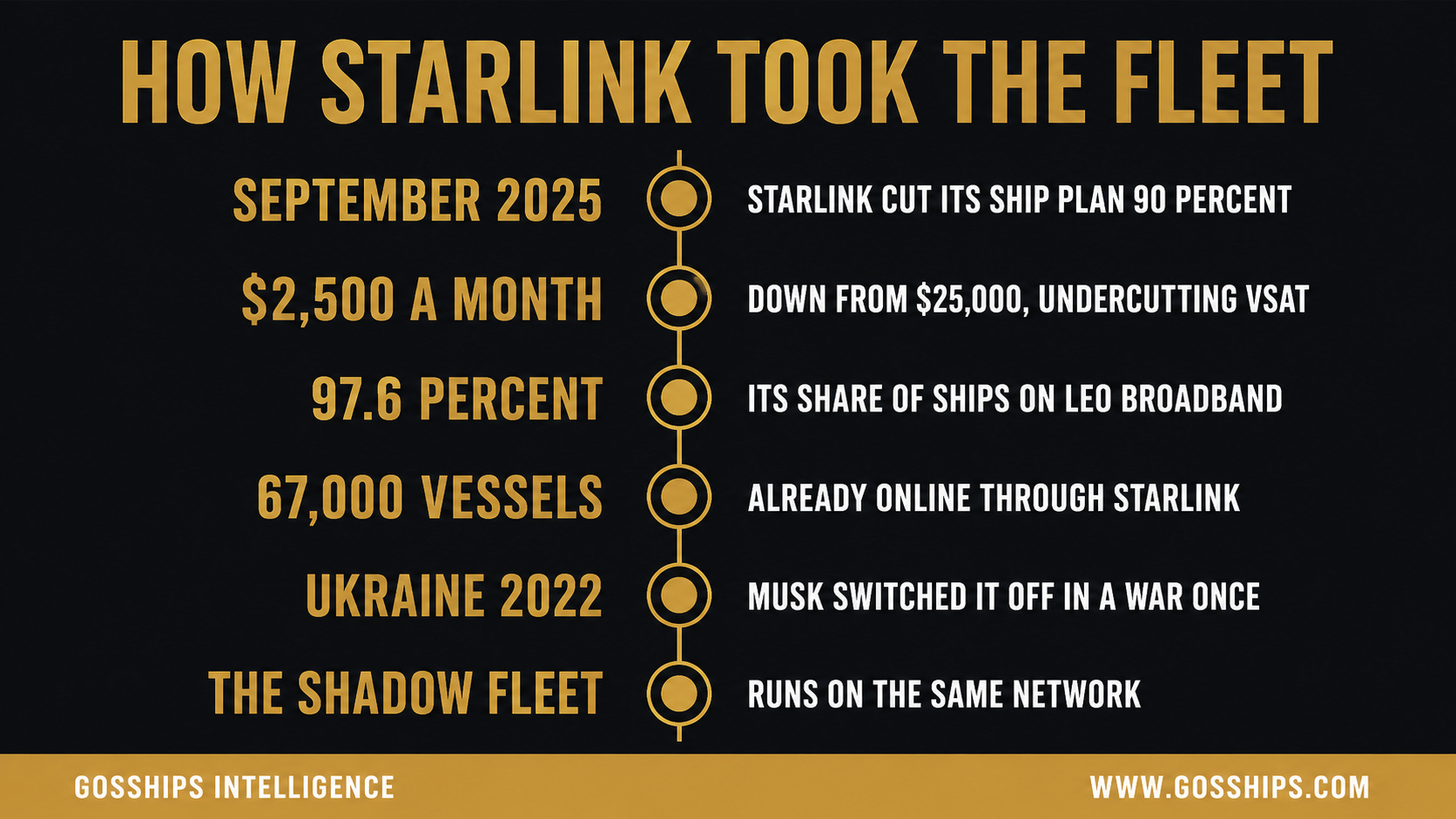
→ SEPTEMBER 2025 - Starlink cut its commercial ship plan by 90 percent
→ $2,500 A MONTH - Down from $25,000, undercutting every VSAT contract
→ 97.6 PERCENT - Starlink’s share of ships on LEO satellite broadband
→ 67,000 VESSELS - Already online through Starlink, and climbing
→ UKRAINE 2022 - Musk switched Starlink off during a war once before
→ THE SHADOW FLEET - Russia’s sanctioned tankers run on the same network
Sources: Splash247; Valour Consultancy; Rappler; Kyiv Independent.
🛢️ The Story
Forget the thought experiment about a tech billionaire buying a shipping line. Elon Musk did something far more consequential, and almost no one in oil shipping called it what it is. He took over the fleet’s nervous system. As of the first quarter of 2026, of all the merchant ships running on next-generation low-earth-orbit satellite broadband, 97.6 percent were connected through SpaceX’s Starlink, according to the maritime research firm Valour Consultancy, which counted 66,866 Starlink vessels out of 68,528 on LEO. By the end of 2025 more than 69,000 commercial vessels were already using Starlink, and the figure climbs every week. Musk does not own the ships. He owns the thing the ships can no longer operate without.
The takeover was won with a price tag. In September 2025 SpaceX cut the cost of its unlimited maritime data plan for IMO-registered commercial ships from 25,000 dollars a month to 2,500 dollars, a 90 percent reduction, and bundled in cheap hardware and a 99.9 percent uptime guarantee, according to Splash247. The legacy VSAT systems it was undercutting could not survive the comparison. Where VSAT offered 1 to 50 megabits per second at 600 to 800 milliseconds of latency on hardware costing 25,000 to 65,000 euros, Starlink offered 25 to 250 megabits at 20 to 40 milliseconds on a terminal costing around 2,000 euros. For a shipowner it was not a close call. Even the old VSAT champions surrendered. KVH, once a VSAT name, grew revenue 27 percent in the first quarter largely by reselling Starlink and OneWeb. The fleet did not just adopt Starlink. It rebuilt itself around it, wiring the network into navigation, engine telemetry, weather routing, cargo systems and crew welfare until the dish on the deck became as essential as the engine below it.
Here is why that matters far beyond faster email at sea. The network the entire fleet now leans on answers to one man, and he has already shown he will switch it off. In 2022 Musk declined to enable Starlink coverage near Russian-occupied Crimea to stop a Ukrainian sea-drone strike on the Sevastopol fleet, deciding on his own that the escalation risk was too high. Later that year he ordered Starlink coverage cut over Kherson during a Ukrainian counteroffensive, and as Rappler and others reported, drones went dark and artillery units that relied on the link struggled to fire. Foreign Policy put it bluntly in March 2026, arguing that Starlink has “privatized geopolitics,” handing one unaccountable executive a strategic power that used to belong to states. Translate that to the sea. The data link that the modern fleet now runs on can be throttled, geofenced or cut by a single private actor with no obligation to any flag, charterer or government.
It is not a hypothetical fragility, either. In August 2025 a global Starlink outage knocked out roughly two dozen US Navy unmanned surface vessels off California, leaving them adrift and out of contact for nearly an hour, a blunt reminder that the world’s most powerful navy had quietly built a single point of failure into its own fleet. If an outage can strand the US Navy’s drones, it can blind a charterer to where its cargo is, or freeze the systems a modern crew uses to run the ship. The more the fleet wires itself into one network, the more a single fault, or a single decision, cascades across all of it at once.
The outage is only the visible failure mode. The quieter one is security. Every Starlink dish is an always-on, high-bandwidth doorway from the open internet straight into a ship’s network, and as connectivity gets wired into navigation and control systems, that doorway becomes the vessel’s largest attack surface. Maritime security specialists warn that without aggressive firewalling and network segmentation a ship’s fastest link becomes its weakest point, a single pipe a hostile actor could ride straight to the systems that steer and run the ship. The fleet spent two years racing to install the cheapest, fastest connection it has ever had, and a fraction of that energy hardening it. A connected fleet is a faster fleet and a more fragile one in the same stroke.
And then there is the part that should stop every compliance officer cold. The same Starlink that powers the Western merchant fleet is what keeps the sanctioned shadow fleet running. A Kyiv Independent investigation, built on interviews with Ukrainian crew who served aboard the vessels, found that Russia’s roughly 1,400-ship shadow fleet cannot navigate, communicate or coordinate without Starlink terminals, and that the ships use Starlink’s bandwidth to broadcast false AIS positions to the world while running their true GPS internally. That dual feed is the operational backbone of sanctions evasion. The economics are almost insulting: a terminal costs about 500 dollars and the service runs roughly 150 dollars a month, so a sanctioned tanker buys the most advanced communications at sea for pocket change. So one man’s satellite network simultaneously runs the fleet the West depends on and the dark fleet the West is trying to sink. Ukraine has openly called on SpaceX to act and asked Washington to investigate the terminals. Nothing has been cut off, because no law yet says it must.
The dependency only deepens from here. The same industry now ordering autonomous and remotely operated tankers is building ships that cannot function at all without a live data link, vessels steered, monitored and corrected from shore over exactly the kind of connection Starlink now dominates. A crewed ship that loses its signal is inconvenienced. A crewless one is a derelict. As the fleet automates, the network stops being a convenience and becomes the thing that keeps the ship a ship, and owners are wiring their newest and most expensive tonnage to the single link most exposed to one man’s judgment.
Which leaves the oil shipping world in a strange and largely unspoken position. The single most important piece of infrastructure in modern shipping is no longer a strait, a canal or a shipyard. It is a constellation owned by one person, depended on by every side at once, and governed by nobody. What that means for the owner wiring his fleet to it, for the trader who can be blinded in an outage, for the underwriter pricing a risk with no precedent, and for the regulator who just learned the shadow fleet’s lifeline is American, is below.
