


⚓ The Gosships Team
Gosships Intelligence Is Published At Gosships.com
For Sponsorship And Partnership Inquiries Contact intelligence@gosships.com
|⚓ About Us | 🛢️ Deep Water Reports | 📋 SwiftAction Training |
🏅 Founding Black Gold Membership (*53 Slots Left)
In 2014, Brazil’s shipbuilding industry employed approximately 80,000 workers.
By 2022, that number had collapsed to 18,000.
Today, it is back to 50,000, and Petrobras projects a return toward nearly 80,000 in the coming years. Petrobras has committed approximately $5.1 billion to build 52 new vessels at Brazilian yards by 2028. Transpetro, the Petrobras shipping subsidiary, is tripling its gas carrier fleet from six vessels to fourteen. The first methanol/ethanol-ready tankers ever commissioned for Brazil’s state oil fleet are scheduled to launch this year.
This is not a tanker market consolidation story. This is the opposite of one.
While the global VLCC market consolidated into MSC and Sinokor through Cyprus-managed entities and Hengli newbuilds, while Fredriksen’s Frontline sold to Hemen on the same day for $162 million, while the dark fleet expanded under flags of convenience, Brazil quietly rebuilt its own national shipbuilding industry through a state oil company that refused to let it die.
This is the comeback nobody saw coming. Here is what it actually looks like, sourced entirely from Petrobras filings, Transpetro announcements, shipyard contracts, and named trade press reporting.
📋 In this issue:
🛢️ The Story
📊 By The Numbers
🔍 Why It Matters
👀 What to Watch
🚨 Gosships Signal
📊 Get The Deep Water Report
→ Global Tanker Market Outlook Q2 2026
📋 Competency-Based Maritime Training
→ SwiftAction
📌 Gosships Data Card
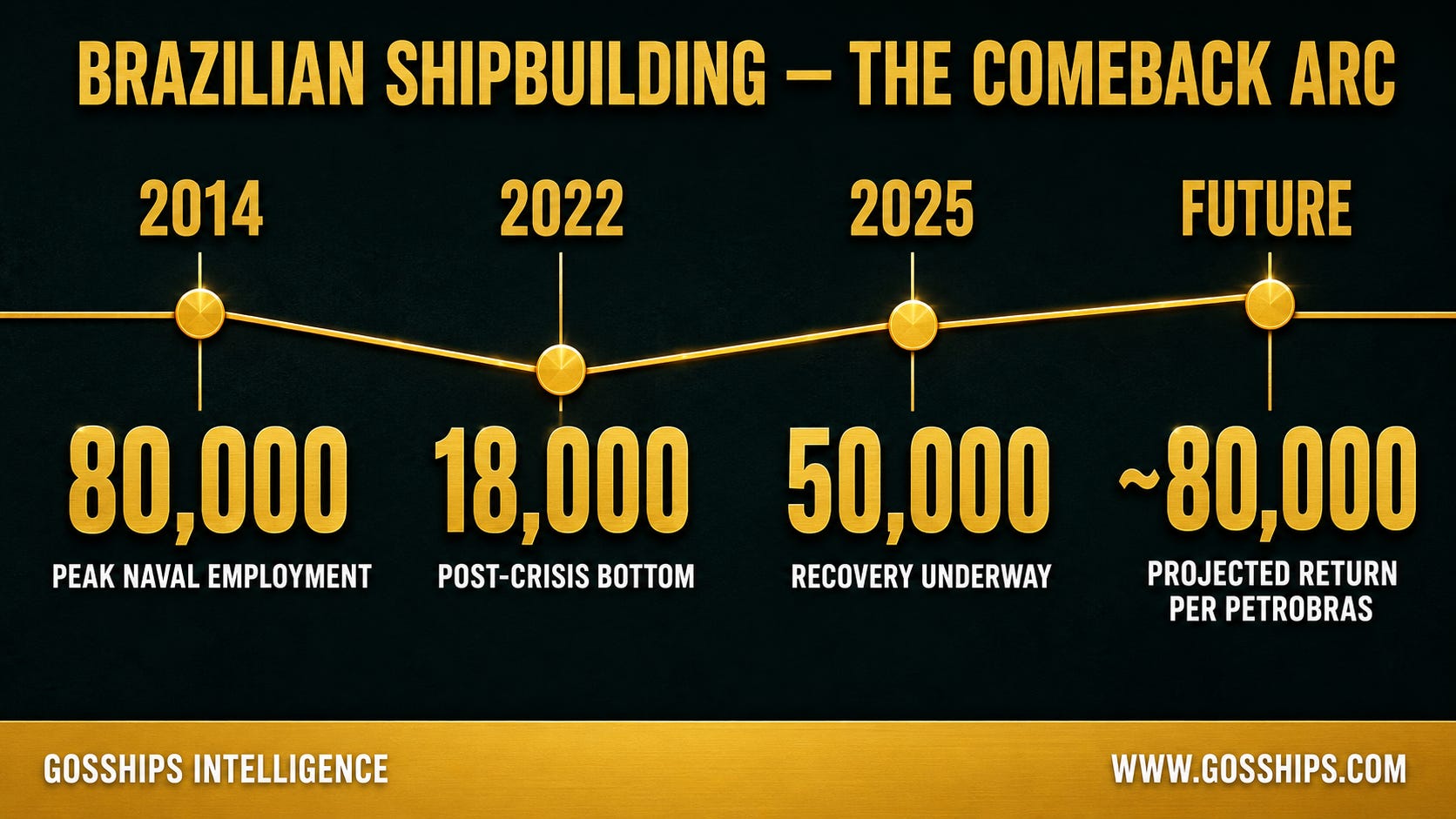
→ Brazilian Naval Industry Peak Employment 2014: Approximately 80,000 Workers Per CPG Click Historical Data
→ Industry Bottom 2022: 18,000 Workers Per Petrobras Data Via MercoPress
→ Current Employment 2025: 50,000 Workers Per Petrobras Data Via MercoPress
→ Mar Aberto Program Jobs Trajectory: Recovery From 18,000 In 2022 To 50,000 In 2025, Projected To Return Toward 80,000 Per Petrobras Via MercoPress
→ Total Petrobras Fleet Investment: Approximately $5.1 Billion (R$29 Billion) Per Rio Times Online
→ Broader Naval And Offshore Investment Package: Approximately $21 Billion (R$118 Billion) Through 2026 Per Rio Times
→ New Vessels Committed By 2028: 52 Vessels Per Petrobras CEO Magda Chambriard At Porto De Itajaí Event
→ January 21, 2026 Contract: $521 Million (R$2.8 Billion) For 5 Gas Carriers, 18 Barges, 18 Pushboats Per Reuters And The Energy Year
→ Transpetro Gas Carrier Fleet Expansion: From 6 Vessels To 14 Vessels Per Petrobras January 2026 Announcement
→ Methanol/Ethanol-Ready Tankers: 4 NVC 615 PT Vessels Designed By Kongsberg Maritime For Consórcio Marenova Per Maritime Executive February 2026
→ Methanol-Ready Tanker Specifications: 150.6m Length, 15,600 DWT, Up To 20% More Energy Efficient, 33% Lower GHG Emissions Per Kongsberg Maritime
→ February 2025 Handy-Class Contract: $278 Million For 4 Tankers At $69.6 Million Each Per Rio Times
→ Rio Grande Shipyard Workforce Expansion: From 200 Workers To 1,400 Workers Per Single Contract Per Rio Times
→ Local Content Mandate: 45% To 65% Brazilian Materials And Labor Per Petrobras Requirements
→ Transpetro Existing Operations: 49 Terminals, 8,500km Of Pipelines, 36 Vessels, Largest Multimodal Oil Logistics Company In Latin America Per US Trade Department
🛢️ The Story
The 2014 Brazilian shipbuilding collapse was supposed to be permanent.
At its peak between 2010 and 2014, the Brazilian naval industry employed approximately 80,000 workers and contributed roughly 1% of national GDP, according to CPG Click historical data. The Fleet Modernization and Expansion Program (Promef), launched in 2004 under President Lula’s first administration, had ordered 49 vessels for Transpetro through Brazilian yards. By 2011, Mauá Shipyard delivered the Celso Furtado, the first oil tanker built in Brazil for the Petrobras System since 1997. Atlântico Sul Shipyard in Pernambuco became the largest shipyard in the Southern Hemisphere. The country reached tenth in the global shipbuilding league.
Then it collapsed. The 2014 Operation Car Wash corruption scandal, the broader Petrobras crisis, the oil price collapse, and the political turbulence of 2015 through 2022 hollowed out the industry. By 2022, naval employment had fallen to approximately 18,000 workers. Atlântico Sul reduced operations dramatically. Enseada Indústria Naval shut down. Rio Naval closed. The industry was widely written off in international trade press as a cautionary tale of state-led industrial policy gone wrong.
That obituary was premature.
The Mar Aberto Program.
In 2023, Lula returned to the presidency. By 2024, Petrobras and Transpetro had launched what the federal government calls the Mar Aberto program, meaning “Open Sea,” a coordinated naval and offshore industrial policy initiative designed to revive Brazilian shipbuilding while simultaneously modernizing the Petrobras fleet. The total Mar Aberto commitment runs to approximately R$32 billion ($6 billion) by 2030, according to MercoPress. The Petrobras-direct fleet investment within Mar Aberto is approximately $5.1 billion (R$29 billion) for 52 new vessels by 2028, according to Rio Times Online citing Petrobras CEO Magda Chambriard at the Porto de Itajaí signing event.
The broader naval and offshore investment package through 2026 totals approximately $21 billion (R$118 billion), according to Rio Times. The local content mandate runs between 45% and 65% Brazilian materials and labor, depending on vessel type.
The Fleet Renewal Contracts.
On January 21, 2026, Petrobras and Transpetro signed contracts worth $521 million (R$2.8 billion) for the construction of five LPG gas carriers at Rio Grande Shipyard (Ecovix), 18 barges at Bertolini Construção Naval da Amazônia in Amazonas, and 18 pushboats at Indústria Naval Catarinense in Santa Catarina, according to Reuters and The Energy Year. The largest single contract, worth R$2.2 billion for the gas carriers, went to Rio Grande Shipyard. President Lula attended the signing ceremony in person.
The gas carrier order represents the most significant single expansion in Transpetro’s history. The new vessels will more than double Transpetro’s gas carrier fleet from six vessels to fourteen, tripling the company’s LPG transport capacity, according to OilPrice and Maritime Executive. The fleet expansion supports rising Brazilian natural gas production, coastal logistics, and inland navigation across the Amazon region and Lagoa dos Patos. The 18 barges and 18 pushboats represent Transpetro’s first entry into inland waterway logistics at scale.
A February 2025 contract had already committed $278 million for four Handy-class product tankers at $69.6 million each, to be built by Consórcio Marenova at the Rio Grande and Niterói yards, according to Rio Times reporting on the Lula signing ceremony at Rio Grande shipyard.
The Methanol-Ready Future.
In February 2026, Kongsberg Maritime announced a contract worth more than NOK 300 million (over $31 million) to design and equip four methanol/ethanol-ready handy size product tankers for Transpetro, according to Maritime Executive and Offshore Magazine. The vessels are built by Consórcio Marenova at yards in Rio Grande and Niterói. The design, Kongsberg’s NVC 615 PT platform, specifies 150.6 meters length overall, 15,600 deadweight tons, and full readiness for methanol or ethanol fuel operation when those bunkering networks become available.
The vessels are projected to deliver up to 20% greater energy efficiency than the tonnage they replace and 33% lower greenhouse gas emissions, according to Petrobras specifications. They are also designed for operation in electrified ports, an emerging regulatory requirement across Brazilian ports under International Maritime Organization green shipping corridor initiatives.
These four vessels are the first methanol/ethanol-ready newbuild tankers ever commissioned for Brazil’s state oil fleet, and among the first designed at national scale for any Latin American state oil company. Brazil’s ethanol production capacity, among the world’s largest, makes the fuel-readiness specification practically deployable rather than aspirational. The vessels are not merely future-fuel-capable. They are future-fuel-practical for the Brazilian operating environment.
The Employment Recovery.
The single Rio Grande Shipyard contract for the Handy-class tankers expanded the yard’s workforce from 200 workers to 1,400 workers over three years, according to Rio Times. The January 2026 gas carrier package generated approximately 9,000 direct and indirect jobs, with around 7,000 at Rio Grande alone, according to Maritime Executive. Across the broader Mar Aberto program, Brazilian shipbuilding employment recovered from 18,000 workers in 2022 to approximately 50,000 workers in 2025, according to Petrobras data published via MercoPress. Petrobras projects the sector could return toward nearly 80,000 workers in the coming years.
The recovery is a 32,000-worker addition in three years. Not promised. Hired.
The Tsakos Shuttle Tanker Tender.
In parallel, Transpetro has been running an international tender for shuttle tankers, which are specialized vessels that load crude directly from offshore Petrobras production platforms. Tsakos Energy Navigation and Samsung Heavy Industries have been linked to the mega tender, according to Riviera Maritime. The shuttle tanker newbuilds are slated for Q3 2026 delivery and are already secured under long-term Petrobras charter agreements. Greek owners control 23% of the global shuttle tanker fleet, with seven of the 12 vessels currently under construction at international yards.
The Hanwha Ocean Brazilian Shipyard.
In August 2025, Korean shipbuilder Hanwha Ocean announced plans to build a shipyard in Brazil, with the project expected to create over 7,000 jobs. According to iMarine, Hanwha is positioning to participate in bidding for Petrobras FPSO, FLNG, and drilling ship projects. Major Chinese shipbuilders including COOEC, CSSC, COSCO, and CIMC have separately signed memoranda of understanding with Brazilian shipbuilders EBR, Rio Grande, Mauá, and Enseada. The international capital is following the Brazilian recovery, not avoiding it.
For the complete rate forecast, fleet supply analysis, and crew competency requirements for the post-recovery Brazilian tanker market through 2028, see our Global Tanker Market Outlook.
📊 By The Numbers
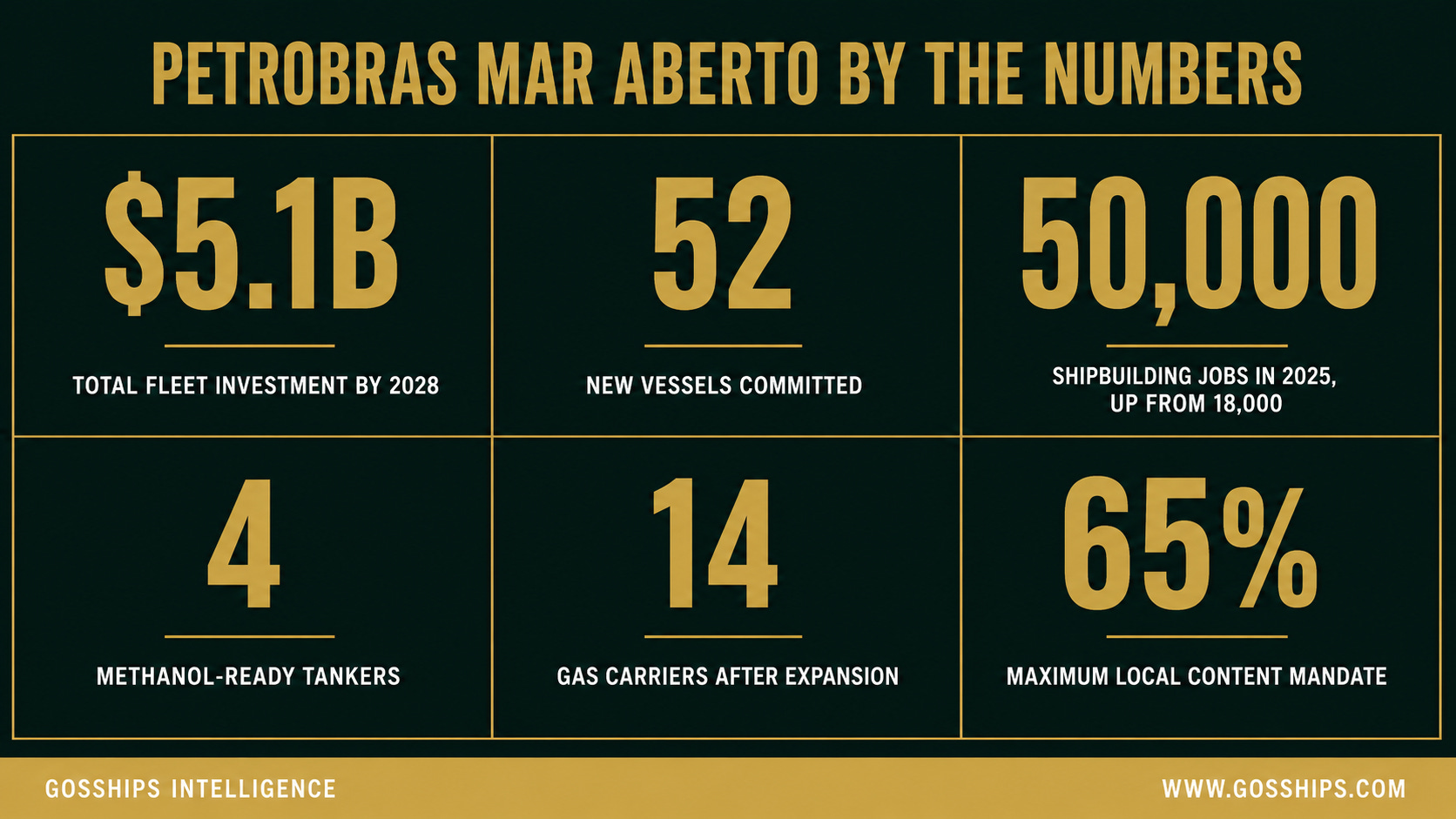
→ $5.1 Billion Total Petrobras Fleet Investment By 2028 Per Rio Times
→ 52 New Vessels Committed Per Petrobras CEO Chambriard
→ Projected Return Toward 80,000 Shipbuilding Jobs In Coming Years Per Petrobras Via MercoPress
→ $21 Billion Broader Naval And Offshore Investment Through 2026 Per Rio Times
→ $521 Million Single January 21, 2026 Contract Package Per Reuters
→ 32,000 Workers Hired Back Since 2022 Per Petrobras Employment Data
→ 4 Methanol/Ethanol-Ready Tankers In The Kongsberg Maritime Contract
→ 14 Gas Carriers In Transpetro Fleet After 2026 Expansion (Up From 6)
→ 33% Lower Greenhouse Gas Emissions On New Vessel Designs Per Petrobras
→ 20% Greater Energy Efficiency On New Vessel Designs Per Petrobras
→ 9,000+ Direct And Indirect Jobs From Single January 2026 Contract Package Per Maritime Executive
→ 7,000 Direct Jobs At Rio Grande Shipyard Alone Per Maritime Executive
→ 45% To 65% Local Content Mandate On Brazilian Vessel Construction Per Petrobras
→ 1,400 Workers At Rio Grande Shipyard Up From 200 Per Single Contract Per Rio Times
→ 49 Terminals Operated By Transpetro Across Brazil Per US Trade Department
📰 Related Coverage
MSC’s Tanker Strategy Is Bigger Than Sinokor. They Have Three More Plays Running In Parallel. Combined Capital: $5 Billion. This Is The Largest Tanker Market Entry In Modern Maritime History.
Sinokor Is Charging $20 Per Barrel To Ship Oil. Last Year It Was $2.50. They Control 40% of Available Tankers. Nobody Can Do Anything About It.
MSC × Sinokor: 40% of the World’s Available Supertankers. $3.3 Billion. Zero Antitrust Investigations. Now It’s Official.
Found this useful? Share Gosships Intelligence with a colleague.
What this means for the global tanker market structure. Why state-led industrial policy worked in Brazil where it failed elsewhere. How the Mar Aberto program differs from Promef. And what other state oil companies should be watching. Below.
🔍 Why It Matters
The Brazilian shipbuilding recovery is the most consequential counter-narrative in the modern tanker market.
