


⚓ The Gosships Team
Gosships Intelligence Is Published At Gosships.com
For Sponsorship And Partnership Inquiries Contact intelligence@gosships.com
|⚓ About Us | 🛢️ Exclusive Report | 📋 SwiftAction Training |
🏅Black Gold Membership (*53 Slots Left)
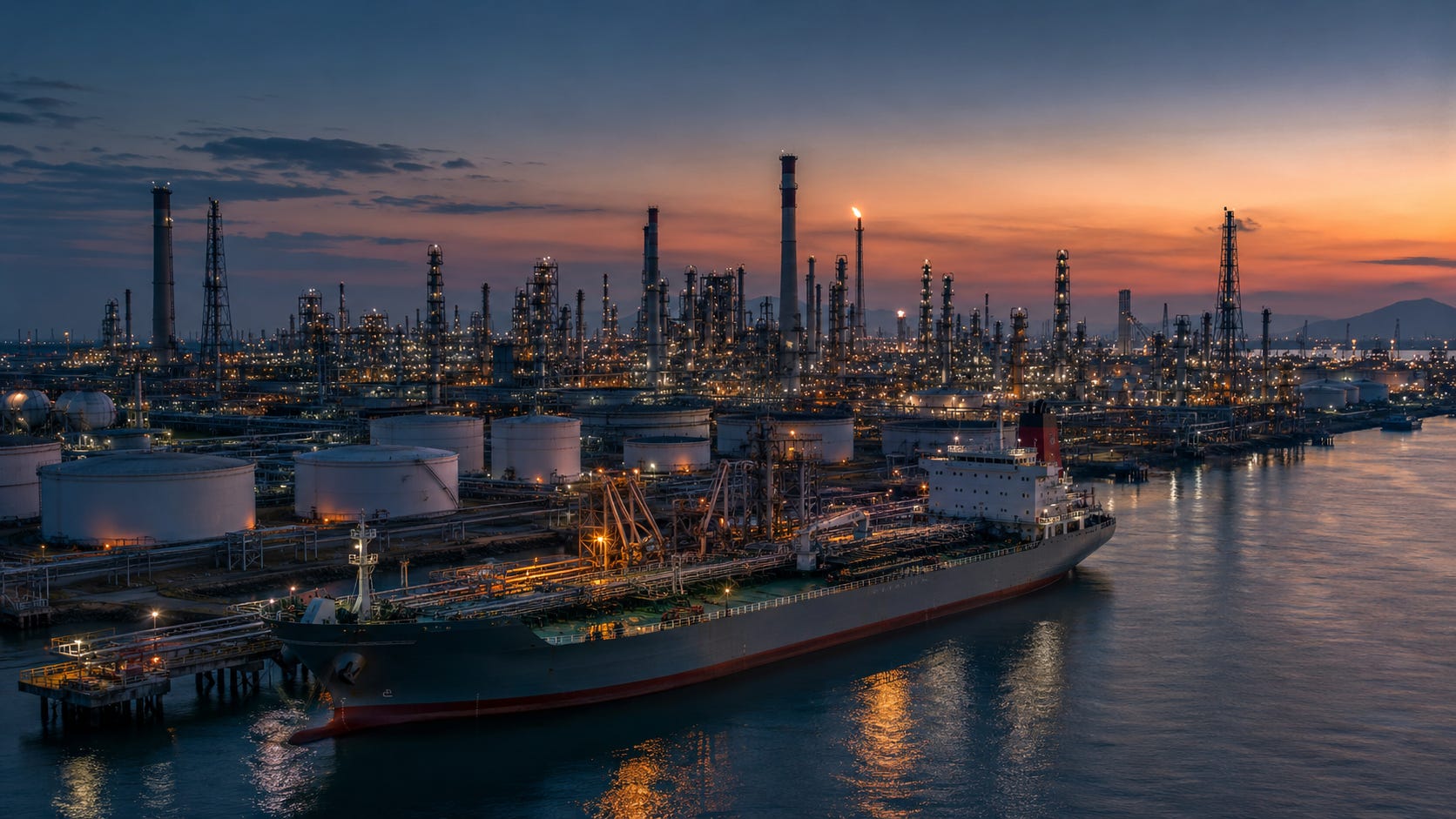
The biggest oil war in a generation made fortunes for traders and European oil companies, and it pushed the two largest names in American energy to their weakest reported profits since 2021. They responded by paying shareholders more than they earned, Exxon by more than double.
📋 In This Issue:
🛢️ The Story
📊 By The Numbers
🔍 Why It Matters
👀 What To Watch
🚨 Gosships Signal
🔔 Not Subscribed? Gosships Intelligence Delivers Oil Shipping Intelligence. Subscribe Here!
📊 Order Our Exclusive Report
→ Global Tanker Market Outlook Q3 2026 Edition
📋 Competency-Based Maritime Training
→ SwiftAction
📌 Gosships Data Card
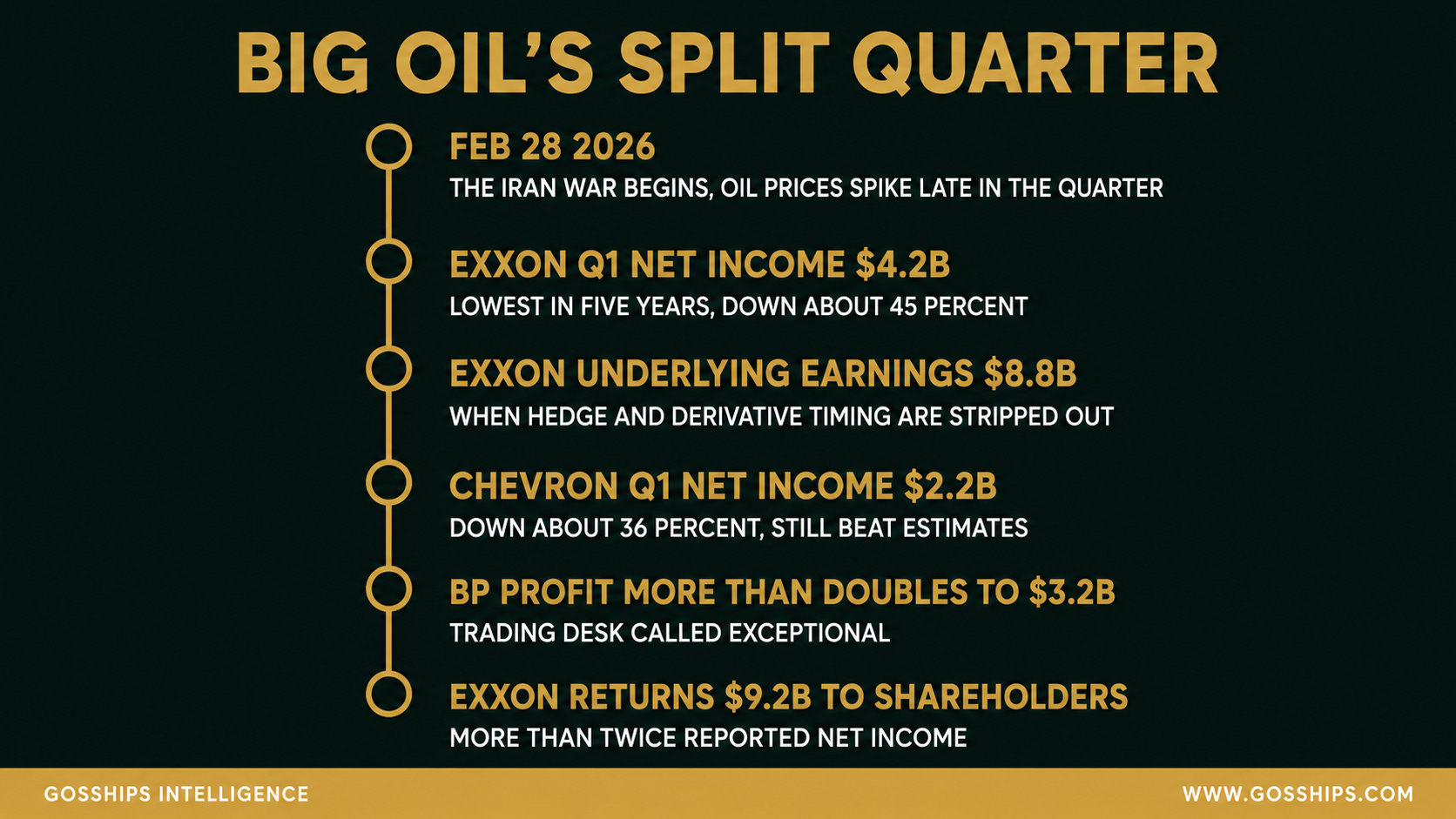
🛢️ Feb 28, 2026: the Iran war begins, spiking oil prices mid-to-late in Q1 (Yahoo Finance; CNBC)
📉 ExxonMobil Q1 reported net income: $4.2B ($1.00/share), its lowest quarterly profit since 2021, down about 45% year over year (Yahoo Finance; The Globe and Mail; StockTitan; CNBC)
🧮 Strip out the war-driven items and Exxon’s underlying earnings were $8.8B ($2.09/share). The core business did not collapse (CNBC; company results)
📉 Chevron Q1 net income: $2.2B, down about 36% year over year, also its lowest since 2021, but it beat Wall Street estimates (CNBC; TIKR; company results)
📈 BP more than doubled profit to about $3.2B, citing an “exceptional” contribution from its oil trading desk (Al Jazeera; CNBC)
💵 Exxon returned $9.2B to shareholders in the quarter ($4.3B dividends + $4.9B buybacks), more than twice its reported net income (CNBC; company results)
Sources: Yahoo Finance; The Globe and Mail; StockTitan; CNBC; Al Jazeera; TIKR; company results.
🛢️ The Story
On February 28, 2026, the Iran war began, and the price of oil lurched upward in the closing weeks of the first quarter. By the time the quarter’s books were closed, the most important fact in the energy market was not that crude had spiked. It was that the spike had split the oil industry cleanly in two, rewarding one half and punishing the other, and that the punishment landed squarely on the two largest names in American oil.
ExxonMobil reported first-quarter net income of $4.2 billion, or $1.00 per share, according to Yahoo Finance, The Globe and Mail, StockTitan, and CNBC. That was down roughly 45% from $7.7 billion, or $1.76 per share, a year earlier, and it was the company's lowest quarterly profit since 2021. For a company of Exxon's scale and history, a profit this low in the middle of an oil war reads like a contradiction. Wars are supposed to be when oil companies print money. This one did the opposite to Exxon’s headline number, and understanding why is the entire story.
The decline was not a collapse in Exxon’s underlying business. It was, in large part, an accounting consequence of the war itself. According to CNBC and the company’s results, Exxon took a $706 million loss on financial hedges that could not be offset by physical shipments, because the war disrupted the timing of those shipments. On top of that, the company absorbed roughly $3.9 billion in unfavorable timing effects from derivatives that were marked to quarter-end prices before the associated physical deliveries were complete. In plain terms, the paper side of Exxon’s trading and hedging book was forced to recognize losses against a price spike, while the physical barrels that would have offset those positions had not yet moved through the system by the time the quarter closed.
Strip those items out, and the picture inverts. Excluding the hedge loss and the derivative timing effects, Exxon’s underlying earnings for the quarter were $8.8 billion, or $2.09 per share, according to CNBC and the company’s results. That is more than double the reported figure. The core business that pumps, refines, ships, and sells oil and gas did not have a bad quarter. It had a strong one. What had a bad quarter was the line on the income statement where derivatives meet a sudden, war-driven price move and a calendar cutoff that does not wait for tankers to arrive.
This distinction matters more than any single number in this article, because the headline figure and the operational reality point in opposite directions. The reported $4.2 billion is real, and it is genuinely Exxon's lowest since 2021. But it is a snapshot distorted by the mechanics of how a price shock hits a hedging book mid-quarter, not evidence that Exxon’s machine broke. The $8.8 billion underlying figure is the truer read of the quarter’s operations. Any reader who walks away believing Exxon’s business cratered has read the headline and missed the footnote, and the footnote is where the war’s real signature sits.
Chevron told a similar story in a lower key. According to CNBC, TIKR, and the company’s results, Chevron posted first-quarter net income of $2.2 billion, down about 36% from $3.5 billion a year earlier. Like Exxon, it was Chevron's lowest quarterly profit since 2021. Unlike Exxon’s headline, Chevron’s number still came in ahead of Wall Street estimates, a sign that analysts had already braced for the war to bite the US majors. Two of the largest and most sophisticated oil companies on earth, in the middle of the biggest oil disruption in years, both printed their lowest reported profits since 2021 in the same quarter. That is not a coincidence. It is the war cutting one way.
Now look at the other half of the industry, and the war cuts the opposite way. The European majors had a very different first quarter. According to Al Jazeera and CNBC, BP more than doubled its profit, to about $3.2 billion from $1.4 billion a year earlier, beating expectations, and the company pointed to an “exceptional” contribution from its oil trading desk. Shell posted first-quarter adjusted earnings of about $6.92 billion, according to the company’s results. TotalEnergies posted quarterly adjusted net income of about $5.4 billion, according to the company’s results. CNBC reported that the European majors’ beat was helped by the quiet rise of their in-house trading desks, the same kind of trading operations that, on the other side of the Atlantic and inside a different accounting and hedging posture, were dragging Exxon’s headline number down.
The split, then, is not about who is a better oil company. It is about who was positioned to let a price spike flow through their trading book as a gain rather than a timing loss, and who was caught with hedges and derivatives marked against deliveries that the war had pushed out of the quarter. The same war that handed BP’s traders an exceptional quarter handed Exxon a $706 million hedge loss it could not offset and $3.9 billion of timing pain. One set of desks rode the wave. The other got the calendar.
Here is where the story stops being an earnings recap and becomes a capital-allocation story, which is the part that actually matters for the years ahead. Faced with its lowest reported profit since 2021, Exxon did not pull back from shareholders. It leaned in. According to CNBC and the company’s results, Exxon returned $4.3 billion in dividends and $4.9 billion in share buybacks in the quarter, a total of $9.2 billion. That is more than twice its reported net income of $4.2 billion. The company paid out, in a single quarter, over double what it reported earning, and it did so while guiding to roughly $20 billion of buybacks for all of 2026 and maintaining a 43-year streak of annual dividend increases, according to CNBC.
Chevron took a more cautious line on the same instrument. According to CNBC, Chevron bought back $2.5 billion of stock in the quarter, 16% less than the prior period and at the bottom of its $10 billion to $20 billion annual guidance range. The cut is the tell. Analysts cited by CNBC and 24/7 Wall St note that trimming buybacks is the first lever the majors pull when crude prices dip, and that Big Oil now runs as a set of “shareholder-friendly cash machines.” When the cash machine senses pressure, the buyback is the first thing it eases off, before dividends and well before long-cycle investment.
The European side made the same move more sharply, and earlier. BP reduced its quarterly buyback from $1.75 billion to $750 million in April 2025, according to CNBC, Reuters, and company statements. Then, on February 10, 2026, with its fourth-quarter 2025 results, BP suspended that $750 million buyback entirely, choosing to prioritize cutting debt and strengthening its balance sheet. TotalEnergies, according to CNBC, said it would adjust and slow the pace of its buybacks to face economic and geopolitical uncertainties. Shell, for its part, guided to 2026 cash capital expenditure of $24 billion to $26 billion alongside ongoing buybacks of about $3.0 billion per quarter, according to the company’s results, keeping the payout running while it spends.
Read across all of it and a single pattern emerges. The defining decision of Big Oil’s war quarter was not how much oil to find. It was how much cash to return, and how fast to throttle the return when prices wobbled. Exxon kept the buyback machine wide open and paid out more than double what it reported earning. Chevron eased its buyback to the bottom of its range. BP suspended its buyback to fix the balance sheet. TotalEnergies slowed. Shell kept spending and buying back in tandem. Every one of these is a statement about priorities, and not one of them is primarily a statement about discovering new barrels.
That is the thread that runs from an earnings table into the tanker market, and it is the reason this quarter matters far beyond the income statements. Capital discipline and shareholder returns, chosen over new long-cycle supply, mean fewer big new sources of seaborne crude entering the pipeline in the years ahead. The majors are not the only source of new oil, but they are among the largest and most capital-intensive, and the projects they choose not to sanction today are the barrels that do not load onto a VLCC five and seven years from now. Where the majors do invest, in LNG, in US gas, and in select oil, reshapes future tanker and LNG-carrier demand and the tonne-miles that come with it. A barrel found in one basin and a cargo of LNG contracted in another do not travel the same routes, do not fill the same ships, and do not generate the same shipping economics.
So the war split Big Oil in two on paper, and it is splitting the future of oil supply in a quieter, slower way underneath. The traders and the European majors banked the spike. The US supermajors absorbed a timing-driven hit to their headline profits and chose to hand shareholders more than they earned rather than redirect that cash toward the next generation of supply. The reported numbers will recover as the timing effects unwind. The barrels that nobody chose to fund this quarter will not reappear on a later income statement. They simply will not exist.
Which raises the question this entire quarter forces onto the table, and the one the market will be answering for years. If the most profitable oil companies in the world respond to an oil war by prioritizing buybacks over drilling, who funds the next barrel, and what does that mean for the tankers and LNG carriers built to move it? The numbers behind that question, and what each player in the shipping market should do with them, are below.
