


⚓ The Gosships Team
Gosships Intelligence Is Published At Gosships.com
For Sponsorship And Partnership Inquiries Contact intelligence@gosships.com
|⚓ About Us | 🛢️ Exclusive Report | 📋 SwiftAction Training |
🏅Black Gold Membership (*53 Slots Left)

The UAE just ripped up 59 years of OPEC membership and walked out with something the oil market cannot easily replace: the spare capacity that cushions every supply shock before it reaches your fuel pump. On April 28, 2026, Al Jazeera reported that Abu Dhabi announced its exit from OPEC, effective May 1, ending the longest unbroken membership of any Gulf nation in the cartel and removing one of the few producers on earth with meaningful idle barrels ready to deploy. When the next supply crisis hits, a future war, a hurricane, a pipeline rupture, the market will reach for that cushion and find it thinner. Rystad Energy’s head of geopolitical analysis, Jorge Leon, said it plainly: “Saudi Arabia is now left doing more of the heavy lifting on price stability, and the market loses one of the few shock absorbers it had left.” That thinning shock absorber is not an abstraction. A less-cushioned oil market is a more volatile one, and oil price volatility travels, without detour, to the forecourt price you pay every time you fill the tank.
📋 In This Issue:
🛢️ The Story
📊 By The Numbers
🔍 Why It Matters
👀 What To Watch
🚨 Gosships Signal
🔔 Not Yet Subscribed? Gosships Intelligence Delivers Oil Shipping Intelligence. Subscribe Here!
📊 Order Our Exclusive Report
→ Global Tanker Market Outlook Q3 2026 Edition
📋 Competency-Based Maritime Training
→ SwiftAction
📌 Gosships Data Card
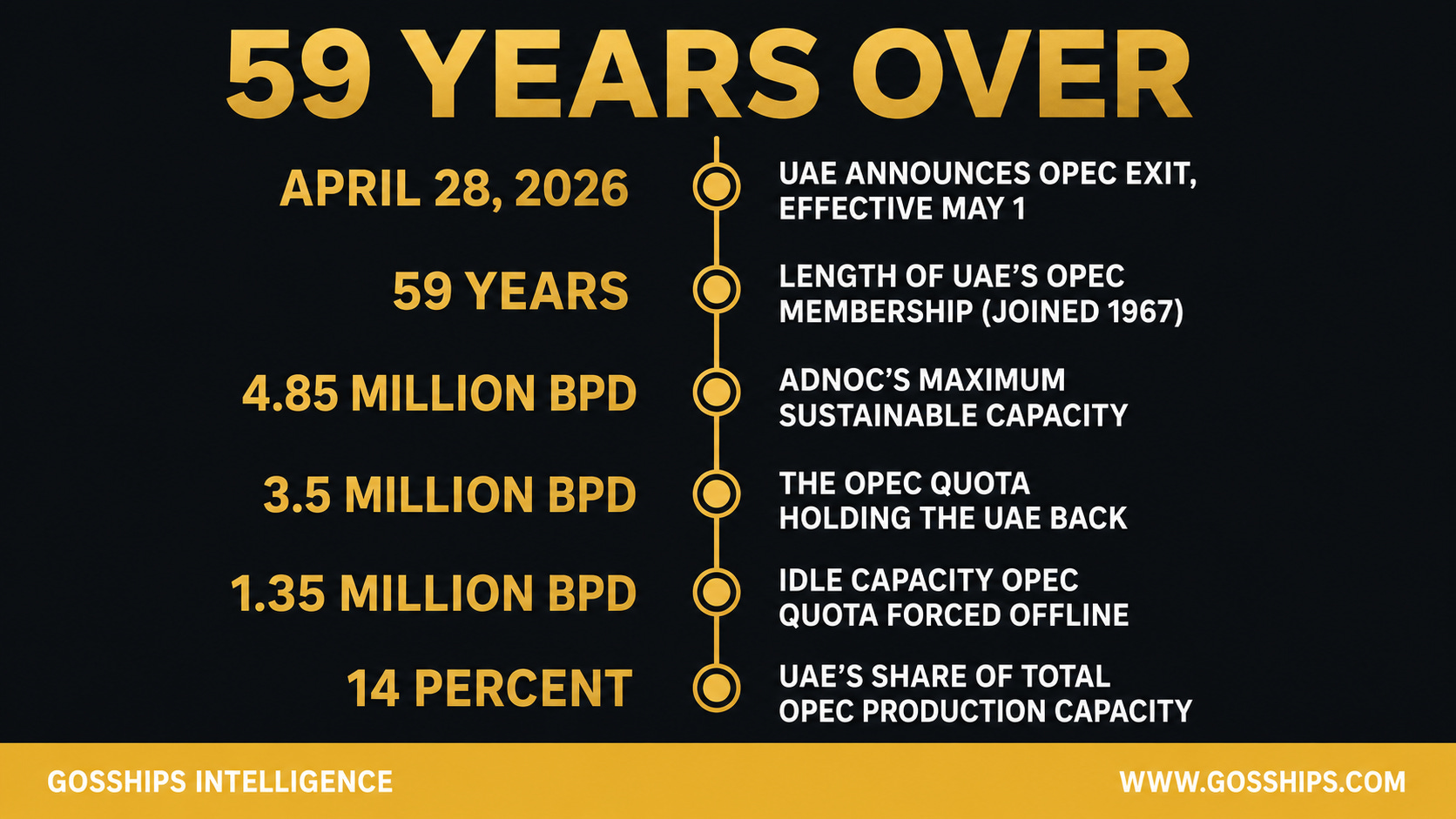
→ APRIL 28, 2026 - UAE announces OPEC exit, effective May 1 (Al Jazeera / WAM)
→ 59 YEARS - Length of UAE’s OPEC membership, joined 1967 (Al Jazeera)
→ 4.85 MILLION BPD - ADNOC’s stated maximum sustainable production capacity (Wood Mackenzie / ADNOC via Argus)
→ 3.5 MILLION BPD - The OPEC+ quota constraining UAE output at exit (Middle East Institute)
→ 1.35 MILLION BPD - Idle capacity the quota forced offline (Middle East Institute / Wood Mackenzie)
→ 14 PERCENT - UAE’s share of total OPEC production capacity (Wood Mackenzie)
Sources: Al Jazeera; WAM; Wood Mackenzie; Middle East Institute; Atlantic Council; Rystad Energy.
🛢️ The Story
Fifty-nine years is a long time to be in anything. The UAE joined OPEC in 1967, when Abu Dhabi was still finding its footing as a state and the global oil order was still being written. On April 28, 2026, Al Jazeera reported that the UAE announced it would leave OPEC and OPEC+, effective May 1, walking out of both the core cartel and its broader alliance with Russia and other non-OPEC producers in a single announcement. William F. Wechsler, senior director of Middle East Programs at the Atlantic Council, said in an April 28, 2026 dispatch that one senior Emirati official described the departure as “a long time coming.” The question the market is now grappling with is not whether the UAE had a right to leave, but what the world does without the spare capacity it carried.
To understand why the UAE left, you have to understand ADNOC’s number. Abu Dhabi National Oil Company, cited by Wood Mackenzie and confirmed via Argus Media’s reporting, states its maximum sustainable production capacity at 4.85 million barrels per day. The country has been building toward that figure for years, backed by a 150 billion US dollar capital investment programme for 2026 to 2030 that ADNOC approved in November 2025, as it pushes capacity from under 4 million barrels per day in 2020 toward 5 million barrels per day by 2027. The UAE has been meeting those targets. By 2024, Wood Mackenzie confirmed, capacity had reached 4.85 million barrels per day.
The OPEC+ quota, however, sat roughly 30 percent below that level. The Middle East Institute’s Colby Connelly, writing on May 8, 2026, reported that the UAE’s tentative May quota was just under 3.5 million barrels per day, leaving a gap of at least 1.35 million barrels per day between what ADNOC could produce and what OPEC would allow. Wood Mackenzie noted that in 2021, OPEC+ talks stalled as the UAE pushed for a higher baseline. The eventual compromise raised the baseline from 3.17 million barrels per day to 3.5 million barrels per day from May 2022, only partially reflecting the capacity growth that had already occurred. The Middle East Institute noted that the UAE’s average capacity utilization rate in 2025 was just 66 percent, the lowest of any major OPEC+ member, compared with 77 percent for Saudi Arabia and 84 percent for Kuwait.
UAE Energy Minister Suhail Mohamed al-Mazrouei told Reuters news agency the decision was “a policy decision” taken “after a careful look at current and future policies related to level of production.” He confirmed to Reuters that the UAE did not raise the issue with any other country before announcing, a detail Al Jazeera reported on April 28. The state media statement, also carried by Al Jazeera, said the exit reflected “the UAE’s long-term strategic and economic vision and evolving energy profile” and acknowledged that the country had “made significant contributions and even greater sacrifices for the benefit of all” during its membership.
Wood Mackenzie’s chairman and chief analyst Simon Flowers, writing with colleagues Alan Gelder, Douglas Thyne, Alexandre Araman, and Dalia Salem on April 29, 2026, called the UAE’s exit “the biggest schism in the organisation since it was founded in 1960.” They noted that political tensions between Saudi Arabia and the UAE had been building for years alongside the quota dispute, and that the two countries had landed on opposite sides of regional disputes, including in Yemen, where Saudi Arabia struck UAE-backed Southern Transitional Council forces in late December 2025. The Atlantic Council’s Wechsler noted that this Saudi-UAE rivalry was “the most significant issue affecting the geopolitics of the Gulf region” in the months before the war with Iran broke out.
The timing of the exit is notable because the closure of the Strait of Hormuz during the Iran war has, for the moment, muted the immediate market impact. Wood Mackenzie noted on April 29, 2026 that the UAE currently has close to 2 million barrels per day of offshore production shut in because of the conflict, constraining its ability to increase supply in 2026 regardless of any policy change. Even once Hormuz transit resumes, the Wood Mackenzie analysts wrote, a return to pre-conflict production levels may take up to six months. The UAE’s exit from OPEC is therefore more likely to reshape supply dynamics in 2027 and beyond than to move barrels in the near term.
That longer-term picture is what concerns analysts most. The Middle East Institute’s Connelly noted that OPEC+ nominal spare capacity had stood at approximately 5.98 million barrels per day as of early 2026, and that the UAE accounted for a disproportionate share of that buffer. Wood Mackenzie confirmed that the UAE accounted for about 14 percent of total OPEC production capacity, a figure that now sits outside the cartel’s direct control. Rystad Energy’s Jorge Leon was direct in his assessment: “Losing a member with 4.8 million barrels per day of capacity, and the ambition to produce more, takes a real tool out of the group’s hands.” Leon added: “Saudi Arabia is now left doing more of the heavy lifting on price stability, and the market loses one of the few shock absorbers it had left.”
That loss of shock absorption is not a theoretical concern. Spare capacity is the margin that OPEC can deploy when a supply disruption elsewhere, a hurricane in the Gulf of Mexico, a coup in a West African producer, a pipeline attack in Central Asia, pulls barrels out of the market. Without that deployable buffer, any disruption hits the physical market harder, and harder physical disruptions produce sharper price spikes. Wood Mackenzie’s April 29, 2026 analysis stated that the UAE’s exit “increases the risk of oversupply weakening prices” from competition in a base case, but also that “if tensions escalate, competition between the UAE and OPEC for market share could send medium-term oil prices sharply lower,” a scenario that would then be followed by the kind of violent recovery spike that historically follows a price collapse. In either direction, the range of outcomes widens.
The geopolitical backdrop amplifies the concern. The Atlantic Council’s Wechsler noted that the UAE now sits in a deeply adversarial relationship with Iran, an OPEC member, whose blockade of the Strait of Hormuz has already disrupted the oil trade that both countries depend on. The UAE also restructured its relationship with Russia during the war, signing a defense agreement with Ukraine and signaling a reversal from its earlier tilt toward Moscow. That leaves Saudi Arabia as the dominant force in what remains of OPEC, carrying a heavier stabilization burden at a moment when Riyadh is itself under financial stress and navigating the aftermath of the Yemen dispute with Abu Dhabi.
For the tanker market, the implications run through every segment of the trade. A more volatile oil price environment, without the UAE’s buffer to soften disruptions, means freight rates that swing more sharply when supply shocks occur. Charterers who relied on a stable, predictable price signal will face wider spreads and harder hedges. Trade routing becomes more unpredictable, because a spike in prices from a supply shock triggers cargo rerouting, changes in refinery economics, and shifts in regional demand that ripple through ton-mile demand. The UAE itself, now free of quota constraints, will eventually produce more barrels, and those barrels will need tankers. Wood Mackenzie says the UAE is on track to hit 5 million barrels per day capacity by 2027. At that production level, the question of which routes, which vessel classes, and which counterparties handle the additional Emirati barrels is one every tanker desk should be modeling now.
What the world’s remaining OPEC members can do to replace the UAE’s role as a swing producer, and whether the tanker market will see a smoother adjustment or a volatile one, is below.
