


⚓ The Gosships Team
Gosships Intelligence Is Published At Gosships.com
For Sponsorship And Partnership Inquiries Contact intelligence@gosships.com
|⚓ About Us | 🛢️ Exclusive Report | 📋 SwiftAction Training |
🏅Black Gold Membership (*53 Slots Left)
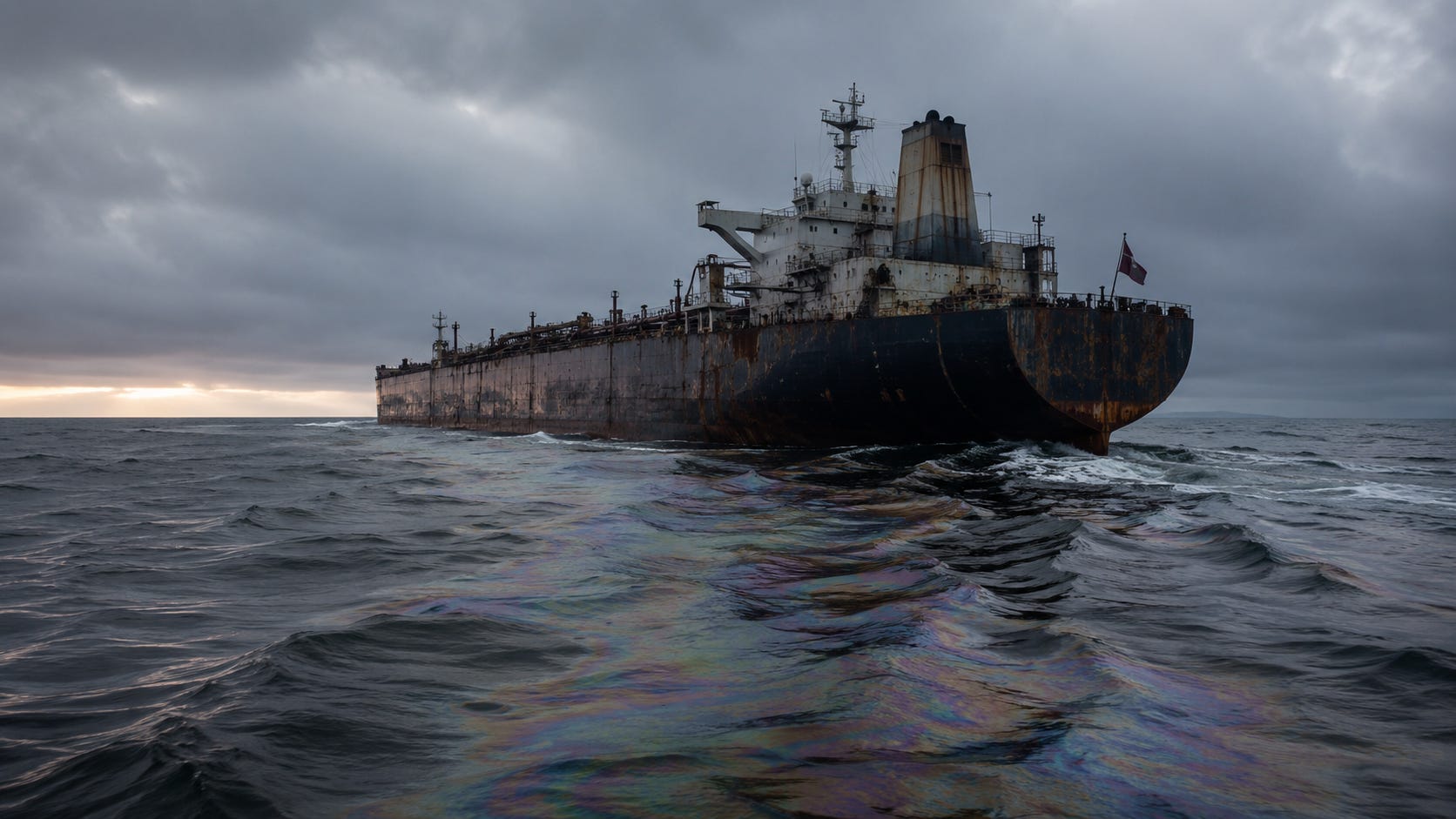
Russia’s shadow fleet of roughly 1,500 oil tankers has aged past the point of institutional comfort, and the people who make their living turning old ships into steel have started saying so out loud. Anil Sharma, chief executive of GMS, which Reuters has identified as the world’s largest buyer of ships for recycling, called the shadow fleet tankers “a ticking time bomb” in January 2026. The Financial Times, reporting in late May and early June 2026, went further, citing industry figures who warned that more than half of the shadow fleet’s oil tankers are in dangerous condition and should be scrapped. One of them, CMB Tech chief executive Alexander Saverys, called the fleet “an accident waiting to happen.” The clearest recent warning came in April 2026, when Swedish authorities boarded the shadow-fleet tanker Flora 1 off the island of Gotland on suspicion that it was the source of a 12-kilometer oil slick in the Baltic Sea, then released it days later when they could not prove the case. No catastrophe followed that time. Experts warned that luck was running out. Every month the fleet keeps sailing, the math on that luck gets worse. The sanctions scorecard, the seizures and the enforcement actions, has been covered before. This is a different and more physical problem: the condition of roughly 1,500 old, uninsured, lightly crewed ships moving crude oil across international waters, with no clear party standing behind them if one of them breaks open.
📋 In This Issue:
🛢️ The Story
📊 By The Numbers
🔍 Why It Matters
👀 What To Watch
🚨 Gosships Signal
🔔 Not Yet Subscribed? Gosships Intelligence Delivers Oil Shipping Intelligence. Subscribe Here!
📊 Order Our Exclusive Report
→ Global Tanker Market Outlook Q3 2026 Edition
📋 Competency-Based Maritime Training
→ SwiftAction
📌 Gosships Data Card
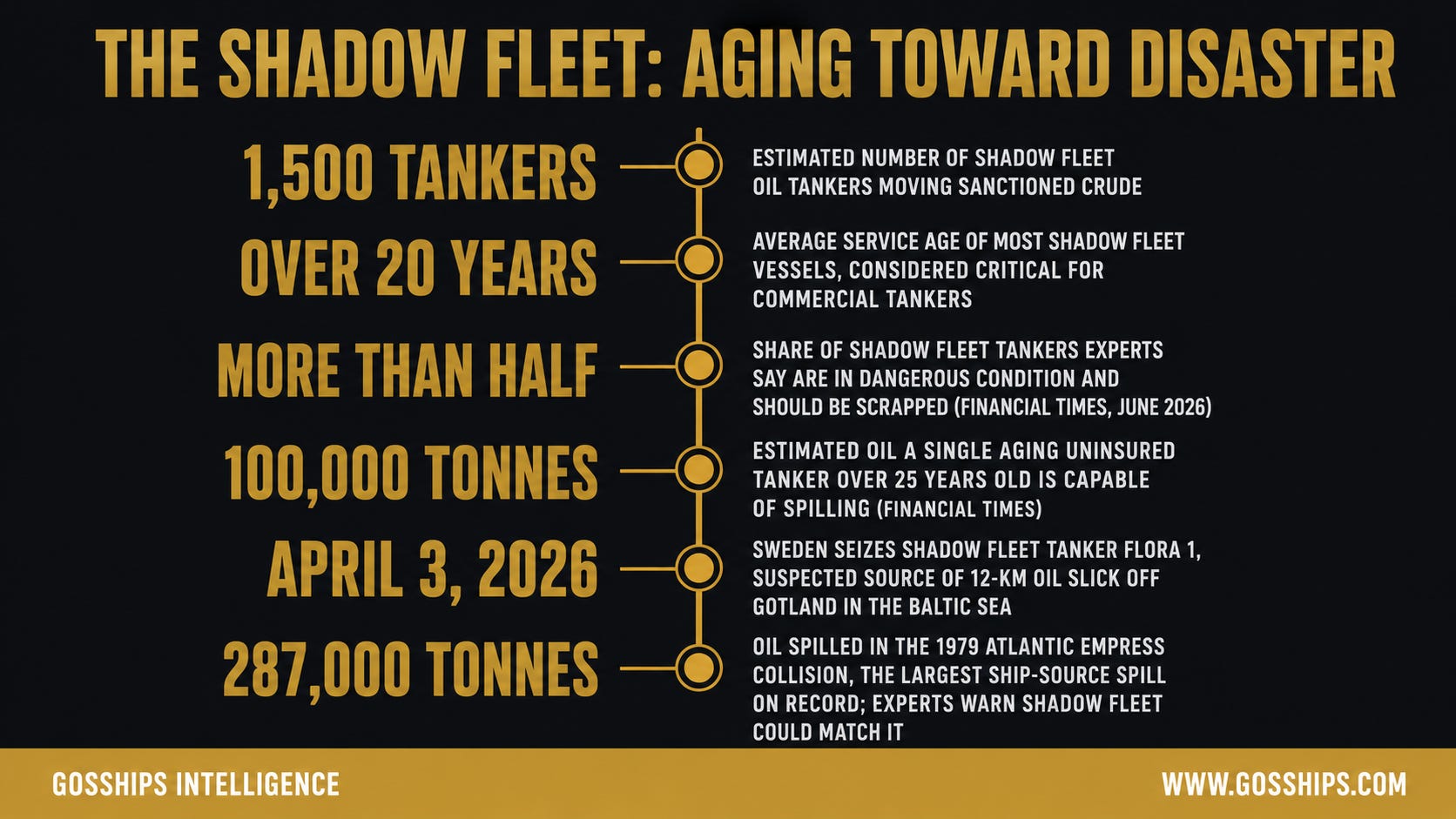
→ 1,500 TANKERS - Estimated number of shadow fleet oil tankers moving sanctioned crude (Financial Times; Euromaidan Press; United24 Media; estimates range from roughly 1,000 to over 1,500 depending on source and methodology)
→ OVER 20 YEARS - Average service age of most shadow fleet vessels, considered a critical threshold for commercial tankers (Financial Times)
→ MORE THAN HALF - Share of shadow fleet tankers industry experts say are in dangerous condition and should be scrapped (Financial Times, June 2026)
→ 100,000 TONNES - Estimated oil a single aging uninsured tanker over 25 years old is capable of spilling (Financial Times)
→ APRIL 3, 2026 - Sweden seizes shadow fleet tanker Flora 1, suspected source of 12-kilometer oil slick off Gotland in the Baltic Sea (Reuters; Swedish Coast Guard)
→ 287,000 TONNES - Oil spilled in the 1979 Atlantic Empress collision, the largest ship-source spill on record; experts warn the shadow fleet could produce a comparable catastrophe (Financial Times; Wikipedia / ITOPF)
Sources: Financial Times; Reuters; Swedish Coast Guard; Euromaidan Press; United24 Media; GMS / Reuters; Wikipedia / ITOPF.
🛢️ The Story
The warning arrived not from a regulator or a naval command, but from someone whose business is removing old ships from the water before they fall apart at sea. Anil Sharma, the founder and chief executive of GMS, the Dubai-headquartered firm that Reuters has identified as the world’s largest buyer of ships and offshore vessels for recycling, called the shadow fleet tankers “a ticking time bomb” in a Reuters interview published in January 2026. Sharma was speaking specifically about Venezuelan-linked tankers the United States had seized, but the structural critique he offered applies to the entire shadow fleet: these ships are old, they are uninsured, they cannot be recycled without sanctions licenses that do not yet exist at scale, and they keep sailing in their hundreds while the legal and financial framework to retire them is built one permit at a time. “Sanctions did not eliminate the trade,” Sharma told Reuters. “They eliminated the rules. The business is still going on, but it is not a rule-based thing.”
The Financial Times, reporting in late May and early June 2026, put figures around the problem. The FT cited leading industry experts who warned that more than half of the shadow fleet’s oil tankers are in dangerous condition and should be scrapped. Most have been in service for over twenty years, a threshold that maritime professionals consider critical for commercial vessels. Many lack adequate insurance, run on minimal maintenance, and carry insufficiently qualified crews. Alexander Saverys, chief executive of the Belgian shipping group CMB Tech, told the Financial Times the vessels are “uninsured, badly maintained, have a substandard crew on board,” and concluded that the fleet is “just an accident waiting to happen.” Euromaidan Press, on June 1, 2026, and United24 Media have separately reported on the fleet’s advanced age and the alarm it has generated among safety professionals. The estimate of roughly 1,500 oil tankers in a broader shadow fleet of approximately 1,800 vessels comes from the brokerage Clarksons, cited by the Financial Times, though estimates vary; Lloyd’s List Intelligence, reporting in January 2026, counted 1,423 tankers across the broader sanctioned fleet working Russian, Iranian, and Venezuelan oil. Any figure in this range represents a fleet large enough that even a small percentage of catastrophic failures produces multiple major incidents per year.
The physical profile of these ships is what makes the warning credible. Shadow fleet tankers are typically older vessels that were retired from legitimate trade when their Western insurers refused to renew their Protection and Indemnity coverage, which is the standard backstop for oil spill liability. Without P&I insurance from a major Western club, a vessel cannot enter most major ports, cannot obtain legitimate flag registration, and cannot get the certification required by the International Maritime Organization. The shadow fleet has bypassed all of these requirements by using non-standard flag registries, typically Comoros, Palau, Gabon, or others operating outside the mainstream, obtaining minimal certification from classification societies willing to work outside established standards, and simply not carrying Western P&I insurance. The Financial Times reported that vessels over twenty-five years old in this category are each capable of spilling on the order of 100,000 tonnes of oil. A single hull failure on a fully loaded vessel of that type would constitute an environmental catastrophe on a scale not seen in decades.
The clearest sign that these failures are not hypothetical arrived on April 3, 2026. The Swedish Coast Guard announced that it had boarded an oil tanker, the Flora 1, off Sweden’s southern coast on suspicion that it was the source of a twelve-kilometer oil slick near the island of Gotland in the Baltic Sea. The vessel had departed the Russian port of Primorsk and was heading to an unclear destination, according to MarineTraffic data cited by Reuters. Sweden's Minister for Civil Defence, Carl-Oskar Bohlin, identified the vessel by name on X and warned that the Russian shadow fleet, made up of older, poorly insured tankers that evade sanctions, poses a significant security and environmental threat. Swedish investigators released the Flora 1 two days later, on April 5, after concluding they had insufficient evidence to prove the vessel had caused the slick. That outcome did not weaken the warning. It sharpened it. A twelve-kilometer slick appeared in the Baltic beside a sanctioned, aging tanker, and the authorities still could not build a provable case, which is exactly the accountability vacuum that makes a larger rupture so dangerous. When the ships are this opaque, even a fresh slick next to a suspect hull can go unattributed.
The historical benchmark experts have pointed to is the 1979 collision between the supertankers Atlantic Empress and Aegean Captain off the island of Tobago. The Atlantic Empress eventually sank, having spilled 287,000 metric tonnes of crude oil into the Caribbean Sea, the largest ship-source oil spill on record, according to the International Tanker Owners Pollution Federation and historical records confirmed by Wikipedia. The Exxon Valdez, by comparison, released approximately 37,000 metric tonnes a decade later, less than thirteen percent of the Atlantic Empress spill. The Financial Times reported that experts warned “luck was running out” to avoid a major ship-source oil spill on the scale of the 1979 collision. The shadow fleet is not carrying light cargo on short coastal passages. It is moving full crude cargoes across open ocean routes, often through waters that have no immediate coast guard presence capable of responding to a major hull failure.
What makes the insurance gap particularly important is not just the cleanup liability question. It is the crew question. The vessels that carry Western P&I insurance also carry, implicitly, the institutional pressure those clubs exert on owners and managers to maintain ships, replace aging components, and certify crew competency. When that pressure disappears because there is no insurer requiring it, the maintenance schedule and the crew certification process become purely discretionary. The Financial Times reported that many shadow fleet vessels run on minimal maintenance and carry insufficiently qualified crews. On a twenty-five-year-old vessel in open ocean carrying a full crude cargo, minimal maintenance and insufficiently qualified crews is not a regulatory abstraction. It is a set of conditions under which catastrophic structural failure becomes probable rather than possible over a long enough operating window.
The liability vacuum that follows a major spill from one of these vessels is the part of the problem that has received the least attention. When the Exxon Valdez ran aground in Prince William Sound in 1989, there was a named corporate owner with deep pockets and a clear legal jurisdiction. The cleanup cost billions of dollars, and the litigation lasted decades, but there was a party to sue. A shadow fleet tanker typically operates through a beneficial owner buried behind nominee directors in a jurisdiction that provides no meaningful legal recourse, flying a flag whose registry has no enforcement capacity, carrying no Western insurance, and transiting waters far from any state with the will or the legal basis to pursue liability. If a shadow tanker like the Flora 1 suffered a major hull rupture in the Baltic, the question of who pays for the cleanup would have no clean answer. The Swedish government would have faced a multi-billion-dollar ecological crisis with no liable party able to fund the response.
The recycling bottleneck that Anil Sharma of GMS identified in January 2026 makes this problem structurally worse. GMS told Reuters that in 2025, sixteen sanctioned tankers were recycled in yards willing to take them, compared to one in 2024 and one in 2023. That represents an improvement, but sixteen vessels per year against a fleet of fourteen hundred to fifteen hundred oil tankers is not a retirement rate. It is a rounding error. Sharma told Reuters that in April 2026 GMS won the first US approval to buy and scrap sanctioned vessels, beginning with four Iran-linked container ships, the Yogi, Timon, Rantanplan, and Bigli, and that taking on sanctioned oil tankers would become feasible only once the US-Israeli war with Iran ended. With that war now winding down, the precedent is in place. But the timeline between a first license and meaningful fleet attrition is measured in years, and the fleet’s average age keeps climbing in the interval. A vessel that was twenty years old when it joined the shadow fleet in 2023 is twenty-three today and heading toward twenty-five with no certified retirement path in sight.
The environmental stakes are not distant. The Baltic Sea, where the slick appeared near the Flora 1 in April 2026, is a semi-enclosed water body with restricted water exchange, significant fishing industries, and coastlines shared by nine nations including Germany, Sweden, Finland, Estonia, Latvia, Lithuania, Poland, Russia, and Denmark. A major oil spill in the Baltic on the scale of the Atlantic Empress would be without precedent in that body of water and would pose an ecological crisis affecting the fisheries, tourism, and drinking water intake of multiple European Union member states simultaneously. The North Sea, the English Channel, the Turkish Straits, and the waters off West Africa all present comparable concentrated risks wherever shadow fleet routing passes through constrained or ecologically sensitive waterways. The question the Financial Times experts posed, whether luck is running out, is not rhetorical for the communities living along those coastlines. The Flora 1 episode showed how close these vessels already sail to disaster. What is uncertain now is the scale of the next one.
The critical distinction between this story and the broader sanctions enforcement narrative is that the spill risk does not require a sanctioned vessel to be caught, boarded, or seized. It requires only that an aging, undermaintained hull with unqualified crew and no adequate insurance suffer a structural failure in transit. That can happen regardless of whether any government has the vessel on a sanctions list. It can happen regardless of whether enforcement coalitions are gaining or losing ground on the broader sanctions question. It is a physical risk baked into the age and condition of the ships themselves, and it grows with every month those ships remain operational without a credible retirement pathway. The world built a fleet of fifteen hundred old tankers to move sanctioned oil. More than half of them, by expert assessment reported in the Financial Times in June 2026, should already be at the breakers. None of the people who built that fleet have committed to paying for what happens when one of them does not make it to port.
