


⚓ The Gosships Team
Gosships Intelligence Is Published At Gosships.com
For Sponsorship And Partnership Inquiries Contact intelligence@gosships.com
|⚓ About Us | 🛢️ Exclusive Report | 📋 SwiftAction Training |
🏅Black Gold Membership (*53 Slots Left)
Saudi Aramco just cut its Asian crude price by the most in over two decades, and the market is already signaling it may not be enough. On July 6, Aramco set the August differential on its flagship Arab Light crude to Asia at $1.50 a barrel below the Oman and Dubai benchmark, an $11 reduction from July and the largest single-month cut in the more than twenty years of Reuters data. A producer of Saudi Arabia’s scale does not discount that aggressively for goodwill; it does so to defend market share it is otherwise losing, here to a crude glut it helped create and to discounted Russian and Iranian barrels undercutting it across Asia. The critical detail is that even after the deepest cut in a generation, Arab Light still lands in Asia above some rival Gulf grades and well above the sanctioned barrels moving on the shadow fleet. This is not a show of strength. It is a defensive repricing, and the early evidence suggests it may already be falling short.
📋 In This Issue:
🛢️ The Story
📊 By The Numbers
🔍 Why It Matters
👀 What To Watch
🚨 Gosships Signal
🔔 Not Subscribed? Gosships Intelligence Delivers Oil Shipping Intelligence. Subscribe Here!
📊 Order Our Exclusive Report
→ Global Tanker Market Outlook Q3 2026 Edition
📋 Competency-Based Maritime Training
→ SwiftAction
📌 Gosships Data Card
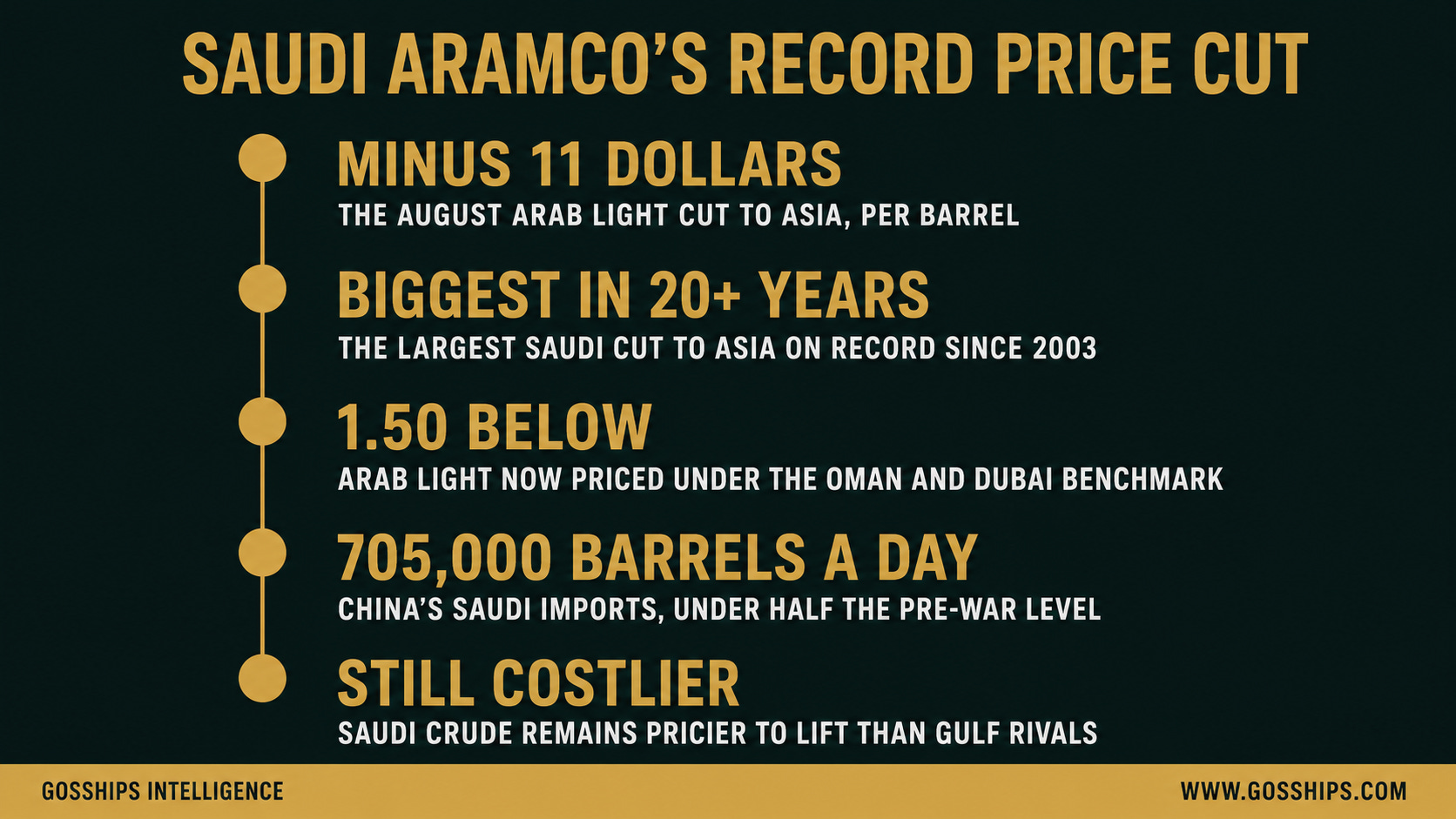
➡️ Minus $11 a barrel the August Arab Light cut to Asia, the biggest in over two decades
➡️ $1.50 below where Arab Light now sits against the Oman and Dubai benchmark
➡️ 705,000 barrels a day China’s Saudi imports in July, less than half the pre-war average
➡️ 3.84 million barrels a day the surplus in the IEA's full-year 2026 outlook
➡️ Still costlier Saudi crude remains pricier to lift into Asia than some Gulf rivals
Sources: Reuters; Bloomberg; Saudi Aramco OSP notice; IEA; Baird Maritime. Reporting July 6 to 10, 2026.
🛢️ The Story
Saudi Aramco does not negotiate the price of its crude one cargo at a time. Once a month it publishes official selling prices, a schedule of formula differentials that fixes what its term customers in each region pay against a local benchmark. For Asia the benchmark is the average of Oman and Dubai, and the differential Aramco sets on Arab Light, its flagship medium grade, is the most closely watched single number in physical crude, because it prices the bulk of Saudi exports and the majority of those exports move to Asia. A wider premium rations tight supply; a discount defends volume. On July 6 Aramco moved that differential from premium to discount in one step, and the size of the step is the story.
Aramco set the August Arab Light differential to Asia at $1.50 a barrel below the Oman and Dubai average, down from a $9.50 premium in July. The $11 swing is the largest single-month reduction in the more than two decades of Reuters price data back to 2003, and it puts the grade in discount for the first time since the 2020 price war. A move of that size is not a reaction to a soft week; it is a deliberate repricing that signals Aramco now values volume over margin, a trade it makes only when it judges the barrels it is losing cannot be recovered at the old price.
Those barrels are in Asia, and China is the epicenter. Chinese imports of Saudi crude ran near 705,000 barrels a day in July, a marginal recovery from a twelve-year low of about 626,000 in June, but less than half the 1.48 million barrels a day China lifted in the three months before the Gulf war began in late February. This is not a routine demand dip. Aramco’s single largest customer has cut its Saudi intake roughly in half and held it there for months, and the state refiner Sinopec went two consecutive months without lifting a single Saudi cargo. When a buyer of that scale withdraws and stays out, the seller’s pricing power goes with it, and the August OSP is Aramco acknowledging exactly that.
The competition it faces is one it structurally cannot match on price. Iranian crude, forced out of the legal market by US sanctions, moves into China at steep discounts on the shadow fleet. Russian ESPO, under Western sanctions since 2022, clears into China and India at levels no unsanctioned Gulf producer can meet without destroying its own netbacks, and India has leaned heavily on that discounted Russian oil. Every such barrel displaces a Saudi one, and because those discounts are a function of sanctions rather than market pricing, Aramco cannot compete them away; it can only chase them down, which is what the August cut attempts.
The pricing decision also collides with a supply glut Aramco helped build. The IEA’s full-year 2026 outlook has pointed to a surplus on the order of 3.84 million barrels a day, demand growth near 700,000 barrels a day meeting a heavy wave of new supply; the mid-year war disrupted that balance without erasing it. A large share of the new supply is OPEC+ itself, unwinding the cuts it imposed earlier, with a further 188,000 barrel a day increase for August in which Saudi Arabia and Russia each add about 62,000. Riyadh is thus running two policies at once, adding volume through OPEC+ while discounting that volume through Aramco to place it. A producer simultaneously raising output and cutting price is not managing a tight market; it is competing for shrinking demand in an oversupplied one.
The timing compounds the problem, because Aramco priced August into a world that lasted two days. It set the differential on July 6, with the US-Iran ceasefire holding, the Strait of Hormuz reopening and Gulf exports normalizing, conditions that justify a bearish, share-defending price. On July 8 the ceasefire collapsed, the United States and Iran exchanged strikes, and Hormuz traffic came back under threat. The August price is now locked against a supply backdrop that inverted within forty-eight hours of being set. If Hormuz tightens, Aramco will have handed Asian buyers cheap crude into a rising market; if the strait reopens, the glut reasserts and the discount looks necessary. Either way the OSP has become a bet whose premise changed two days after it was placed.
The cost of that bet is measured in foregone revenue. An $11 reduction across the several million barrels a day Aramco ships to Asia is a large recurring cash sacrifice, with one analyst estimate putting the give-up on the order of hundreds of millions of dollars a month. That matters because Aramco's dividend now runs ahead of its free cash flow: the 2026 base payout of roughly $87.6 billion tops last year's free cash flow of about $85.4 billion, and first-quarter gearing climbed to 5.3 percent from 4.5 percent as the company took on debt to cover the gap. Both the Saudi budget and the kingdom's diversification program depend on that payout. Discounting into Asia widens the gap between what Aramco earns and what it has committed to distribute, a gap closed only by more borrowing, lower capital spending or a smaller dividend. The OSP is therefore not just a market-share lever; it is a claim on the sovereign balance sheet.
The most consequential finding is that the cut may not work, and the reason is as much geographic as commercial. Asian refiners and traders noted immediately that even at $1.50 under the benchmark, August-loading Arab Light still lands a few dollars a barrel above some competing Gulf grades. The cause is Hormuz: Saudi Arabia's main crude terminal at Ras Tanura lies inside the Gulf, reachable only by transiting the Strait of Hormuz, so lifting there now carries a war-risk freight surcharge that traders put at roughly $4 to $5 a barrel, while Abu Dhabi's ADNOC can move barrels through terminals outside the strait, including ship-to-ship transfer at Sohar in Oman. The OSP cut lowers the price of the crude; it does nothing about the cost of getting a tanker in to lift it. A discount recaptures share only if it makes the seller the cheapest credible option, and Aramco has shown it can post its largest cut since 2003 and still fail that test, undercut on freight by nearer Gulf grades and on price by the discounted Russian and Iranian barrels on the shadow fleet. The binding constraint on Saudi share is therefore not the OSP alone but the sanctioned barrel and the Hormuz war premium, and a headline price cut is the wrong instrument against either.
For the tanker market the cut is a demand signal that has to be read against its cause. Cheaper Saudi crude mechanically invites more lifting, and incremental Gulf-to-Asia cargoes are the long-haul VLCC trade that sets crude freight. But the discount exists because the market is oversupplied, and that same oversupply keeps tonnage readily available and caps any rate response once the Hormuz risk premium fades. The correct reading is not that a Saudi price cut tightens tankers; it is that extra liftings landing on top of a glut raise volume without raising pricing power, and any freight spike from here is a war premium on Hormuz, not a demand story.
Above the monthly number sits the structural question. For fifty years Saudi Arabia has been the swing producer that sets the world price by adjusting its own output. The August OSP points to a narrower role: a producer adjusting its price to chase demand it no longer commands, competing on discount against two sanctioned adversaries in the one region where consumption is still growing. If the largest cut in more than two decades cannot recover Asian share, the salient development is not the price. It is that effective price-setting power in the world’s most important crude market is migrating from the Saudi OSP to the sanctioned, shadow-fleet barrel that is increasingly setting the clearing price in its place.
