


⚓ The Gosships Team
Gosships Intelligence Is Published At Gosships.com
For Sponsorship And Partnership Inquiries Contact intelligence@gosships.com
|⚓ About Us | 🛢️ Exclusive Report | 📋 SwiftAction Training |
🏅Black Gold Membership (*53 Slots Left)
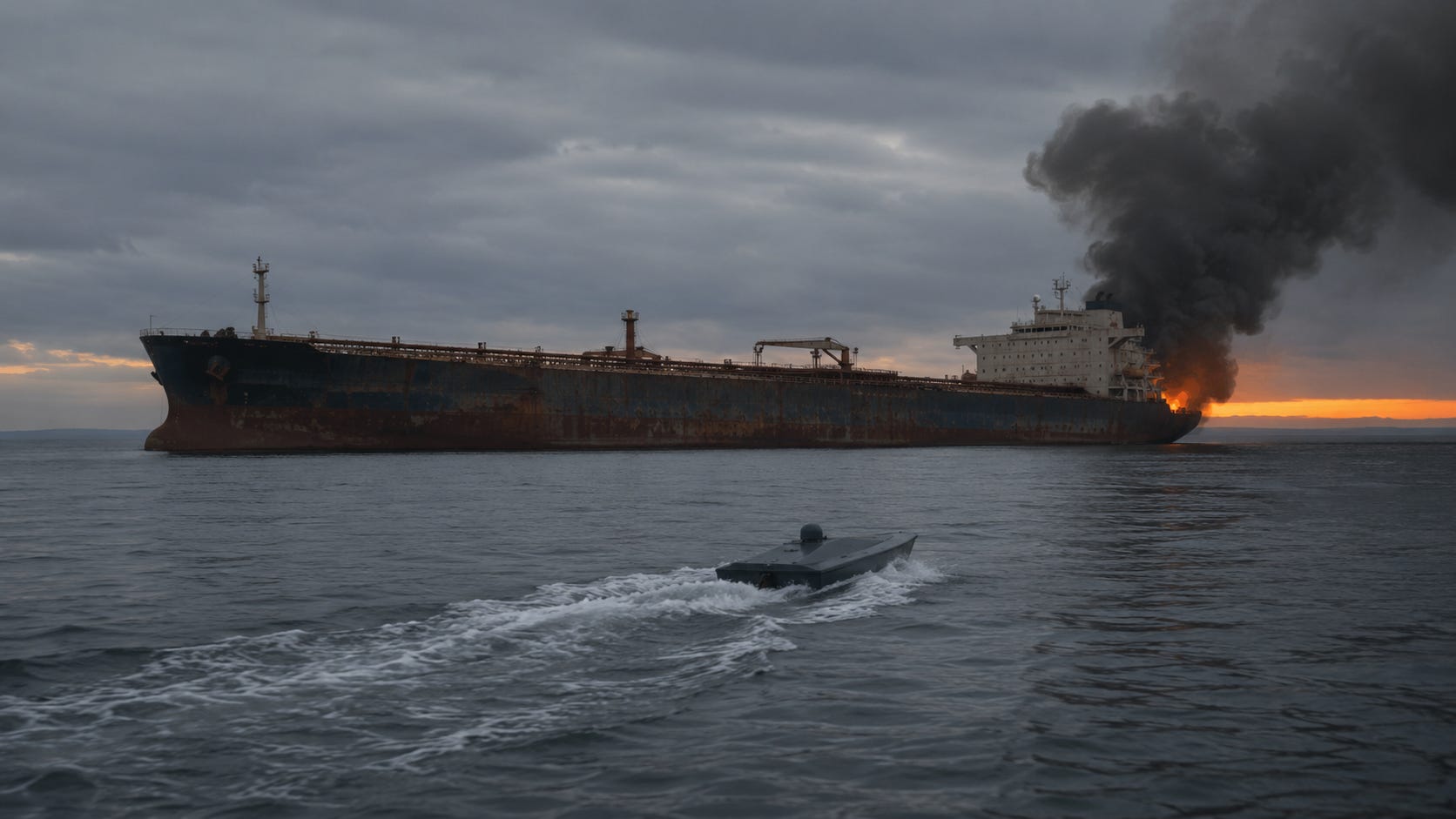
For three years, sanctions could not sink Russia’s shadow fleet. In one week, drones started doing it for them.
While Russian warships escort sanctioned tankers through the Baltic to shield them from European coast guards, Ukraine has opened a second front on the other side of the continent, and it is not trying to detain these ships. It is trying to burn them. Ukraine's drone commander says his aircraft hit nineteen shadow-fleet tankers in the Sea of Azov in seventy-two hours, a naval drone struck one of Russia's large sanctioned crude carriers in the Black Sea, and within the same week the pressure on Russia's refineries forced Moscow to ban diesel exports entirely.
📋 In This Issue:
🛢️ The Story
📊 By The Numbers
🔍 Why It Matters
👀 What To Watch
🚨 Gosships Signal
🔔 Not Subscribed? Gosships Intelligence Delivers Oil Shipping Intelligence. Subscribe Here!
📊 Order Our Exclusive Report
→ Global Tanker Market Outlook Q3 2026 Edition
📋 Competency-Based Maritime Training
→ SwiftAction
📌 Gosships Data Card
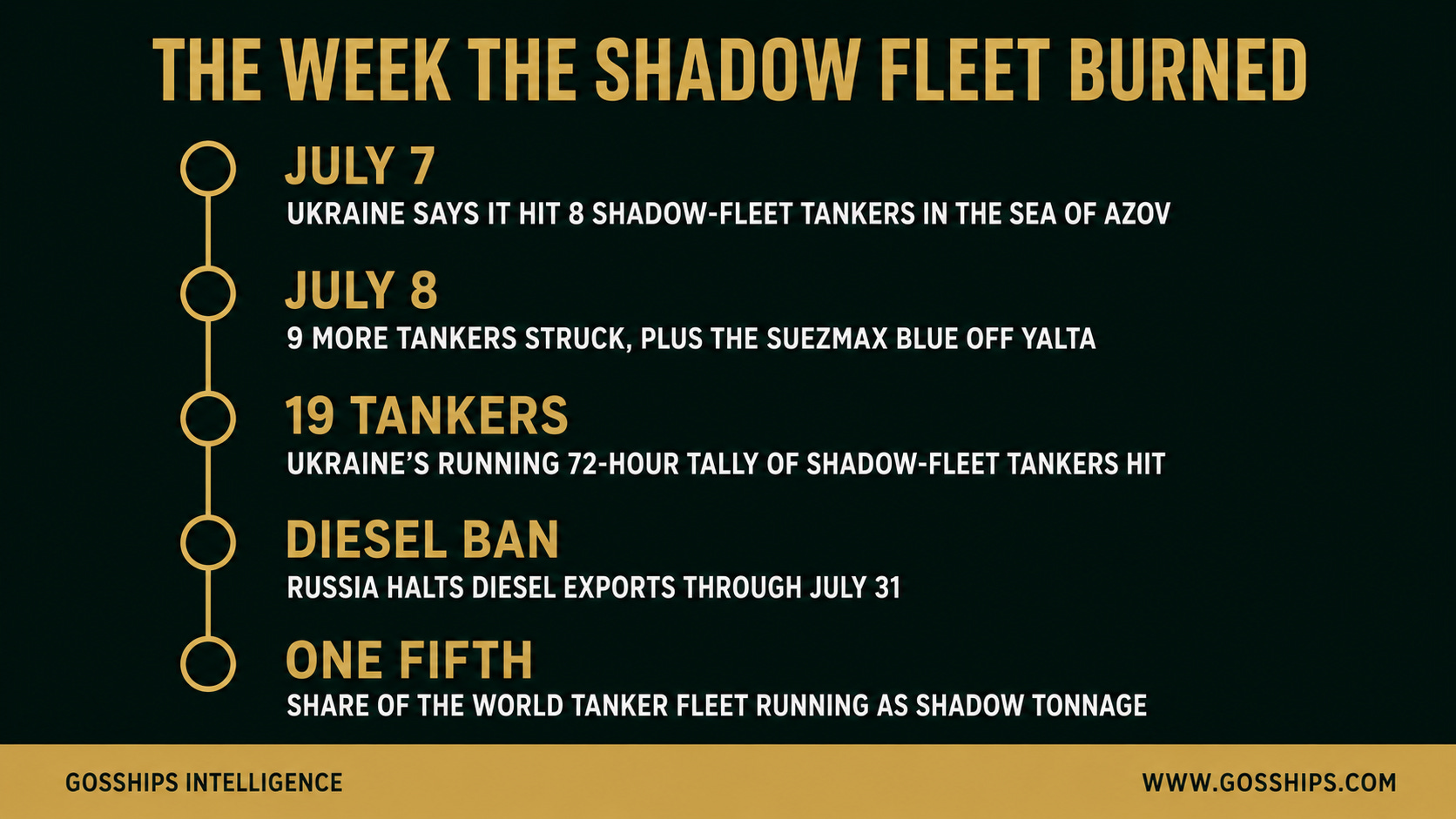
➡️ July 7 Ukraine says its drones hit 8 shadow-fleet tankers in the Sea of Azov
➡️ July 8, 9 more tankers struck overnight, and a Sea Baby drone hit the Suezmax Blue off Yalta
➡️ 19 tankers shadow-fleet tankers Ukraine claims to have hit in 72 hours
➡️ Diesel ban Russia halts diesel exports through July 31 as refinery strikes bite
➡️ One fifth the share of the world tanker fleet now running as shadow tonnage
Sources: Kyiv Independent; Ukrainska Pravda; Security Service of Ukraine (SBU); Militarnyi; Bloomberg; CNN. Reporting July 7 to 9, 2026. Vessel-strike counts are Ukrainian military claims.
🛢️ The Story
For three years, the West tried to strangle Russia’s shadow fleet with paperwork. It sanctioned individual tankers, blacklisted their fake insurers, and pressured the flag registries that shelter them, and for three years the fleet kept growing anyway, past a thousand vessels carrying close to a fifth of the world’s oil-tanker capacity. This week, a different method arrived, and it does not involve paperwork. Ukraine has started destroying the shadow fleet one hull at a time, from the air and from the sea, and it is doing far more damage in days than sanctions managed in years.
The campaign is being run by Robert Brovdi, the commander of Ukraine’s Unmanned Systems Forces, better known by his callsign Madyar. On July 7 he said his long-range drones had struck eight shadow-fleet tankers in the Sea of Azov overnight, along with a dry-cargo ship and a ferry, and that the tankers were left badly damaged and on fire; some outlets put that night’s tally as high as ten. The vessels were small and old, roughly 7,000 deadweight tonnes and 140 metres long, built between 2006 and 2012, and Ukraine identified several of them, including the Venera-3, the Sanar-1 and Sanar-17, the Klimena, the Teti, the Alexei Savrasov, and the Penelopa. The following night, July 8, Ukraine said it hit nine more shadow-fleet tankers in the same waters. Across roughly seventy-two hours, by Kyiv’s running tally that spans more than those two nights, Ukrainian forces struck around twenty vessels, nineteen of them shadow-fleet tankers.
The larger target came next. On the morning of July 8, the Security Service of Ukraine sent a Sea Baby naval drone into the Black Sea and rammed it into the stern of the Blue, a Suezmax crude carrier, near the occupied Crimean coast off Yalta and inside Ukraine’s own claimed exclusive economic zone. The Blue is not an anonymous Azov coaster; it is a full-size sanctioned tanker, blacklisted by the European Union, the United Kingdom, Switzerland, Canada, Australia, New Zealand, and Ukraine for hauling Russian oil in defiance of sanctions. Russian aircraft scrambled to destroy the drone before it reached the ship and failed. The SBU released footage of the strike and framed it in the plainest possible terms: these tankers generate the oil revenue that funds the war, so the tankers are now targets.
Understand the asymmetry, because it is the whole story. A Sea Baby is an uncrewed motorboat packed with explosives, cheap enough to build in numbers and expendable by design. A Suezmax is a roughly 270-metre asset worth tens of millions of dollars, and the small Azov tankers, however humble, are the workhorses that keep Russian fuel and oil products moving out of shallow southern ports. Ukraine has worked out that it does not need to sink every ship to win this exchange. It only needs to make the shadow fleet uninsurable, uncrewable, and unusable in the waters around Crimea, and every burning tanker and every released video moves it closer to that goal. The stated aim, in the words of Ukrainian officials, is to strip Crimea of its role as the rear base for Russia’s entire southern war effort, and the tankers are part of that logistics chain.
Now place this next to the other half of the picture, the half that makes it strange. On the far side of Europe, in the Baltic and the English Channel, Russia’s Navy has been escorting these same sanctioned tankers in warship convoys, driving off the German coast guard and daring European enforcers to intervene. The shadow fleet, in other words, is now fighting a two-front war. On one flank it is so well protected that a NATO coast guard will not board it; on the other it is being hunted and set alight by cheap, expendable drones that cost a fraction of the ships they burn. Moscow can shield the fleet from lawyers and coast guards. It has not worked out how to shield it from Ukraine.
The consequences did not stay at sea. Ukraine has spent months hitting the other end of the chain, the refineries, and by early July the sustained drone campaign had pushed Russian refinery runs to multi-year lows and, by some estimates, knocked out a large share of the country’s refining capacity. The result was a domestic fuel crisis, with queues and rationing spreading across Russian regions. On July 8, Deputy Prime Minister Alexander Novak, sitting beside President Vladimir Putin on state television, announced that Russia would ban diesel exports outright through July 31 to keep fuel flowing to its own market. This is not a small lever. Russia supplied roughly eleven percent of the world’s diesel in 2025, and pulling that volume off the export market sent global diesel prices to multi-year highs. A country that sells energy to fund a war has just been forced to stop selling one of its most important fuels in order to keep its own trucks and tractors running.
That is the throughline that makes this a shipping story and not just a war story. The shadow fleet exists to move Russian oil past sanctions and turn it into cash. Ukraine has decided to attack that machine at both ends at once, burning the tankers that carry the oil and the refineries that make the product, and the diesel ban is the first clear sign that the strategy is drawing blood in Moscow, not just in the headlines. For the tanker market, it introduces a risk that did not exist a year ago: the possibility that a chunk of the world’s sanctioned tonnage, the tonnage that has been quietly propping up global oil supply, can be removed not by regulators but by force, faster than anyone was modeling.
None of this comes with clean confirmation, and honesty requires saying so. The vessel counts, the nineteen tankers, the eight and the nine, come from Ukraine’s own military and its commanders, who have every incentive to advertise success, and independent verification of exactly how many ships were hit and how badly lags well behind the claims. What is firmer is the shape of the campaign, which multiple outlets and released footage corroborate, and the diesel export ban, which Russia announced itself. Even discounting the numbers, the direction is unmistakable: the shadow fleet has become a live military target, and the war over Russian oil has moved from the sanctions office to the water.
Which leaves the question worth sitting with. For three years the West tried to price the shadow fleet out of existence and failed, because there was always another obscure owner, another flag, another fake insurer willing to take the risk for the margin. Ukraine is not trying to price it out. It is trying to burn it out. If drones can do in a week what sanctions could not do in three years, the uncomfortable implication is that the most effective sanctions enforcement of this entire war is not being carried out by any government’s treasury. It is being carried out by a man with a callsign and a fleet of exploding boats, and no one has yet decided what that means.
