


|⚓ About Us | 🛢️ Deep Water Reports | 📋 SwiftAction Training |
🏅 Founding Black Gold Membership (*52 Slots Left)
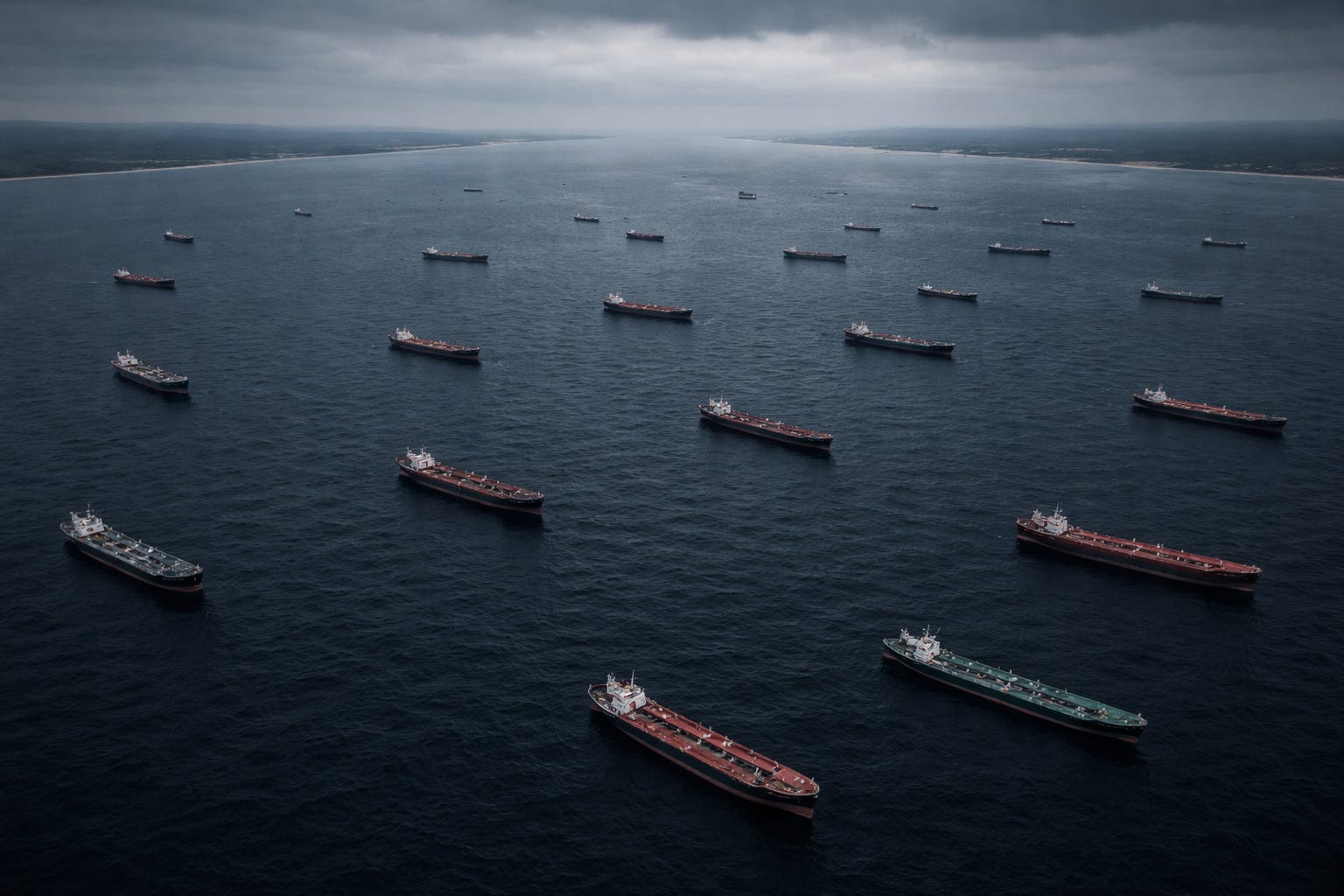
On Tuesday night, April 7, the United States and Iran announced a two-week ceasefire, brokered by Pakistan. Oil prices crashed more than 15%. Brent fell from $109 to approximately $94 per barrel. WTI plunged from approximately $113 to approximately $96, according to Trading Economics. On Wednesday morning, Defense Secretary Pete Hegseth told reporters: “The strait is open.” Joint Chiefs Chairman Dan Caine said: “I believe so, based on the diplomatic negotiation,” according to CNBC. The shipping data tells a different story. Five bulk carriers transited the Strait of Hormuz on the morning of April 8, all via the IRGC-controlled corridor near Larak Island, according to Windward Maritime Intelligence. No oil tankers. No blue-chip operators. No major oil companies. Before the war, approximately 135 ships crossed the strait daily, according to Kpler. Then, hours after the ceasefire announcement, a drone struck a pumping station along Saudi Arabia’s East-West pipeline, the only high-capacity alternative to Hormuz, according to Bloomberg and the Financial Times. The pipeline was running at 7 million barrels per day of emergency capacity at the time of the strike, according to OilPrice.com. The ceasefire arrived. The strait didn’t open. And then the backup got hit.
📋 In this issue:
🛢️ The Story
📊 By The Numbers
🔍 Why It Matters
👀 What to Watch
🚨 Gosships Signal
📊 Get The Deep Water Report
→ Global Tanker Market Outlook Q2 2026
📋 Competency-Based Maritime Training
→ SwiftAction
📌 Gosships Data Card
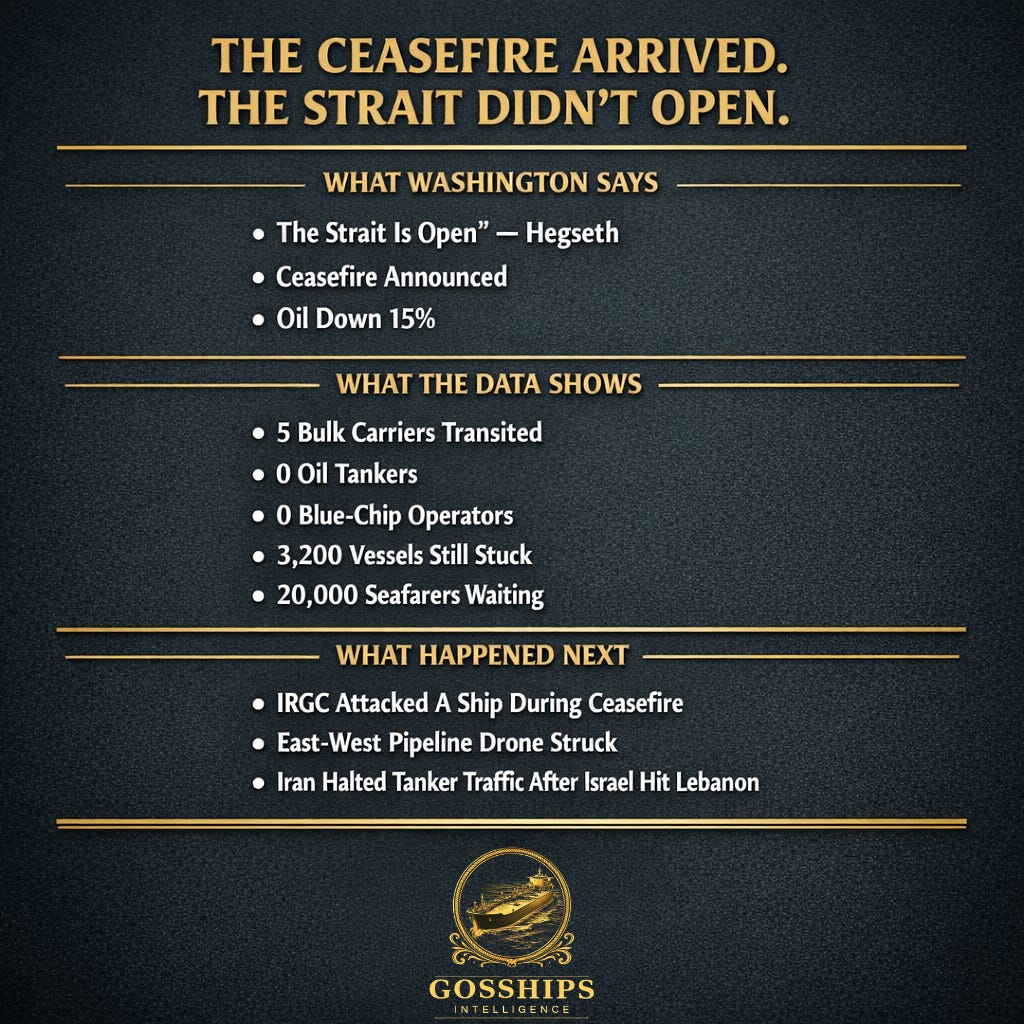
→ April 7: US-Iran Two-Week Ceasefire Announced, Brokered By Pakistan (CNBC, Al Jazeera)
→ April 8: Brent Crashes To ~$94, Down 15%. WTI Crashes To ~$96, Down 15%. (Trading Economics)
→ April 8: Hegseth Says “The Strait Is Open.” (CNBC)
→ April 8: 5 Bulk Carriers Transited Hormuz. Zero Oil Tankers. All Via IRGC Corridor. (Windward)
→ Pre-War: ~135 Ships Per Day Through Hormuz (Kpler)
→ April 8: ~3,200 Vessels With ~20,000 Seafarers Still Stuck West Of Hormuz (Windward)
→ April 8: 800+ Vessels Trapped In The Persian Gulf (Bloomberg)
→ April 8: East-West Pipeline Drone Struck At 1 PM Local Time. Pumping Station Hit. (Bloomberg, FT)
→ April 8: IRGC Attacked A Commercial Vessel With A Qadir Cruise Missile During Ceasefire (Windward)
→ April 8: Iran Halted Tanker Traffic After Israel Struck Lebanon (Fars Via CNBC)
🛢️ The Story
Three things happened on April 8, the first full day of the ceasefire, that show the gap between what Washington is saying and what the shipping data shows.
First, the strait did not open. Iran’s Foreign Minister Abbas Araghchi said on X that safe passage would be possible “via coordination with Iran’s Armed Forces and with due consideration of technical limitations,” according to CNBC. He did not define what those technical limitations are. Windward Maritime Intelligence reported that five bulk carriers were tracked outbound as of 12:00 on April 8, all confined to the IRGC-controlled corridor near Larak Island. No blue-chip operators were present and major oil majors were absent, according to Windward. The cohort “reflects the same risk-tolerant operator profile seen throughout the blockade, not a return of mainstream commercial shipping,” Windward reported. Coordination with Iranian armed forces is still required for all transits, according to Windward. Insurance coverage for war-risk exclusions remains a blocking constraint. Approximately 3,200 vessels with approximately 20,000 seafarers remain west of Hormuz, including nearly 800 tankers and cargo ships, according to Windward. Bloomberg reported that just three ships were observed leaving the region on Wednesday and that the strait “remained largely blocked.” Bloomberg reported that more than 800 freighters are stuck inside the Gulf.
A shipping executive told CNBC: “We have no information about how we could transit the Strait of Hormuz during the ceasefire. We are not in contact with the Iranian authorities. The most important for us is the safety of our crew members, and if we were deciding to transit, we need absolute guarantees about the safety of our crew members.”
A senior shipping executive told IBTimes: “This is not a full reopening. It’s a cautious thaw. Insurance premiums are still sky-high, and no one wants to be the test case if things go wrong again.”
Iran’s state news agency Fars reported later on April 8 that oil tanker traffic through the strait has been halted after Israel attacked Lebanon, according to CNBC. The White House denied the strait was closed, with press secretary Karoline Leavitt telling reporters: “This is a case of, what they’re saying publicly is different privately,” and that “we have seen an uptick of traffic in the strait today,” according to CNBC. Kpler oil analyst Matt Smith told CNBC the strait may see only “10 to 15 vessels, given that Iran is still vetting who goes through,” which would be a similar pace to recent days during the war.
Second, the IRGC attacked a commercial vessel during the ceasefire. The IRGC claimed responsibility for striking a vessel with a Qadir cruise missile, describing it as “an Israeli ship,” according to Windward. The vessel is owned by Chartworld and was previously time-chartered by ZIM, the Israeli container carrier, until October 2023, according to Windward. That expired charter arrangement is the likely basis for the IRGC’s classification. The vessel has no current Israeli commercial connection, according to Windward. The attack occurred within hours of ceasefire negotiations concluding, “confirming that the IRGC was conducting strikes on commercial vessels up to, and potentially through, the ceasefire window,” Windward reported.
Third, the East-West pipeline was struck by a drone. At approximately 1:00 PM local time on April 8, a drone struck a pumping station along Saudi Arabia’s East-West pipeline, the 1,200-kilometer Petroline system running from Abqaiq to Yanbu, according to Bloomberg and the Financial Times. The pipeline was running at its emergency capacity of 7 million barrels per day to bypass the closed Strait of Hormuz, according to OilPrice.com. Bloomberg reported the damage was limited and contained. One source told Investing.com the pipeline was not shut down. Saudi Aramco declined to comment, according to Bloomberg.
The pipeline has an emergency expanded capacity of 7 million barrels per day, according to OilPrice.com. Actual crude exports via Yanbu have averaged approximately 5 million barrels per day, according to Investing.com. This was not the first time the pipeline has been targeted. In May 2019, IRGC-directed drones launched from Iraq struck the same pipeline system, in what the Washington Institute identified as a rehearsal for the Abqaiq attack four months later.
The Dallas Fed warned in March 2026 that Yanbu is “within range of both Iranian and Houthi missiles from Yemen, as are the waterways in the Red Sea.” That warning materialized on ceasefire day.
Related Coverage:
Hormuz Is More Than 90% Closed. Iran’s Parliament Speaker Just Threatened to Close the Bab El-Mandeb. If Both Chokepoints Shut, the Only Alternative Route Disappears. There Is No Third Option.
Goldman Sachs Just Called This “The Largest Supply Shock in the History of the Global Crude Market.”
MSC × Sinokor: 40% of the World’s Available Supertankers. $3.3 Billion. Zero Antitrust Investigations. Now It’s Official.
Oil prices are pricing a headline. The shipping industry is pricing reality. Brent fell 15% on the ceasefire announcement. But the strait has not reopened. The pipeline that bypasses the strait has been attacked. The IRGC is still hitting ships. Iran is still controlling who transits and when. War risk insurance has not been restored. 3,200 vessels are still stuck. And negotiations do not begin until Saturday in Islamabad.
What the gap between the oil price and the shipping data means for tanker rates, gas prices, and every vessel owner with a ship in the Persian Gulf, is below.
📊 By The Numbers
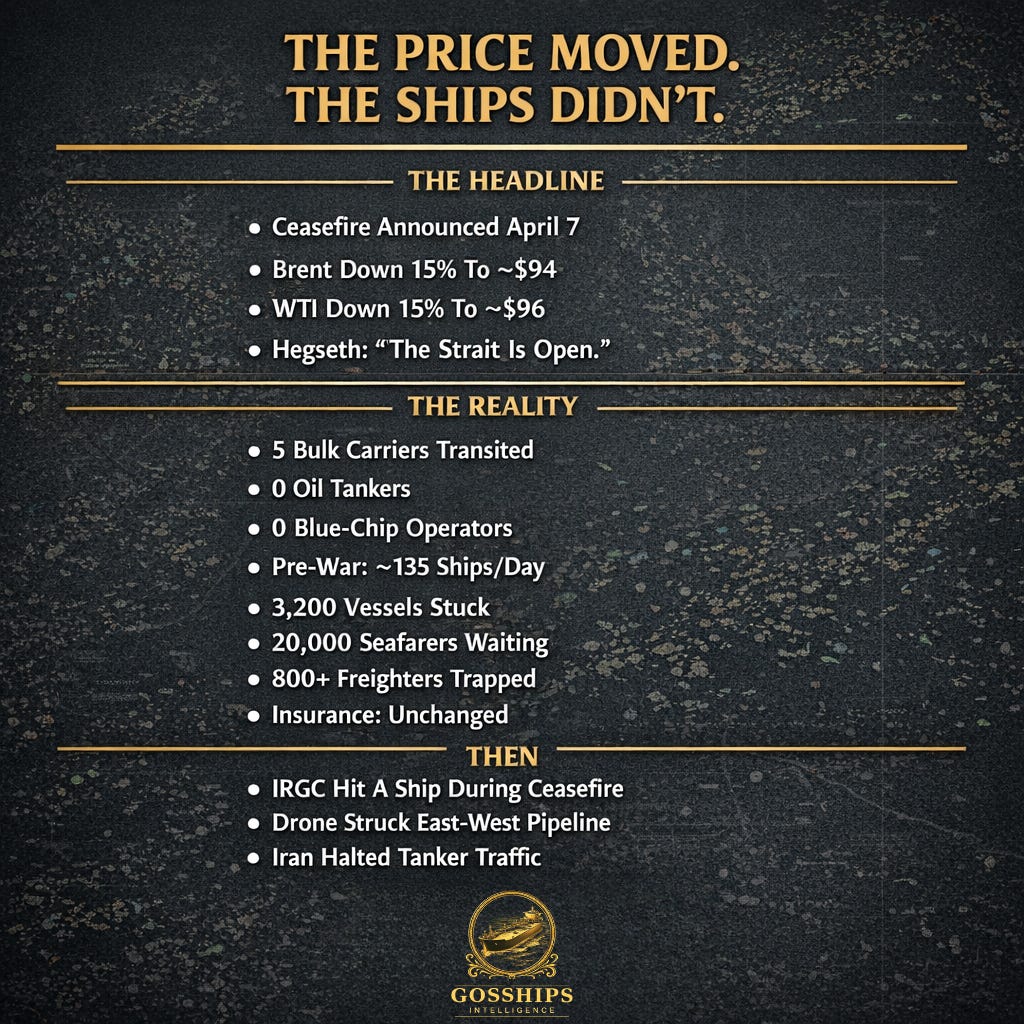
→ 15%: Brent Price Crash On Ceasefire Announcement, From $109 To ~$94 (Trading Economics)
→ 15%: WTI Price Crash, From $113 To ~$96 (Trading Economics)
→ 5: Vessels Transiting Hormuz On April 8, All Bulk Carriers, All Via IRGC Corridor (Windward)
→ 0: Oil Tankers Transiting Hormuz On April 8 (Windward)
→ 0: Blue-Chip Operators Transiting Hormuz On April 8 (Windward)
→ ~135: Ships Per Day Through Hormuz Pre-War (Kpler)
→ ~3,200: Vessels Still Stuck West Of Hormuz (Windward)
→ ~20,000: Seafarers Awaiting Evacuation (Windward, IMO)
→ 800+: Freighters Trapped Inside The Persian Gulf (Bloomberg)
→ 7 Mbd: East-West Pipeline Capacity At Time Of Drone Strike (OilPrice.com)
→ 1: Commercial Vessel Attacked By IRGC During Ceasefire (Windward)
→ 2 Weeks: Ceasefire Duration. Negotiations Begin Saturday In Islamabad.
🔍 Why It Matters
The ceasefire is a diplomatic event. It is not a shipping event. The difference between the two is the story.
