
|⚓ About Us | 🛢️ Deep Water Reports | 📋 SwiftAction Training |
🏅 Founding Black Gold Membership (*52 Slots Left)
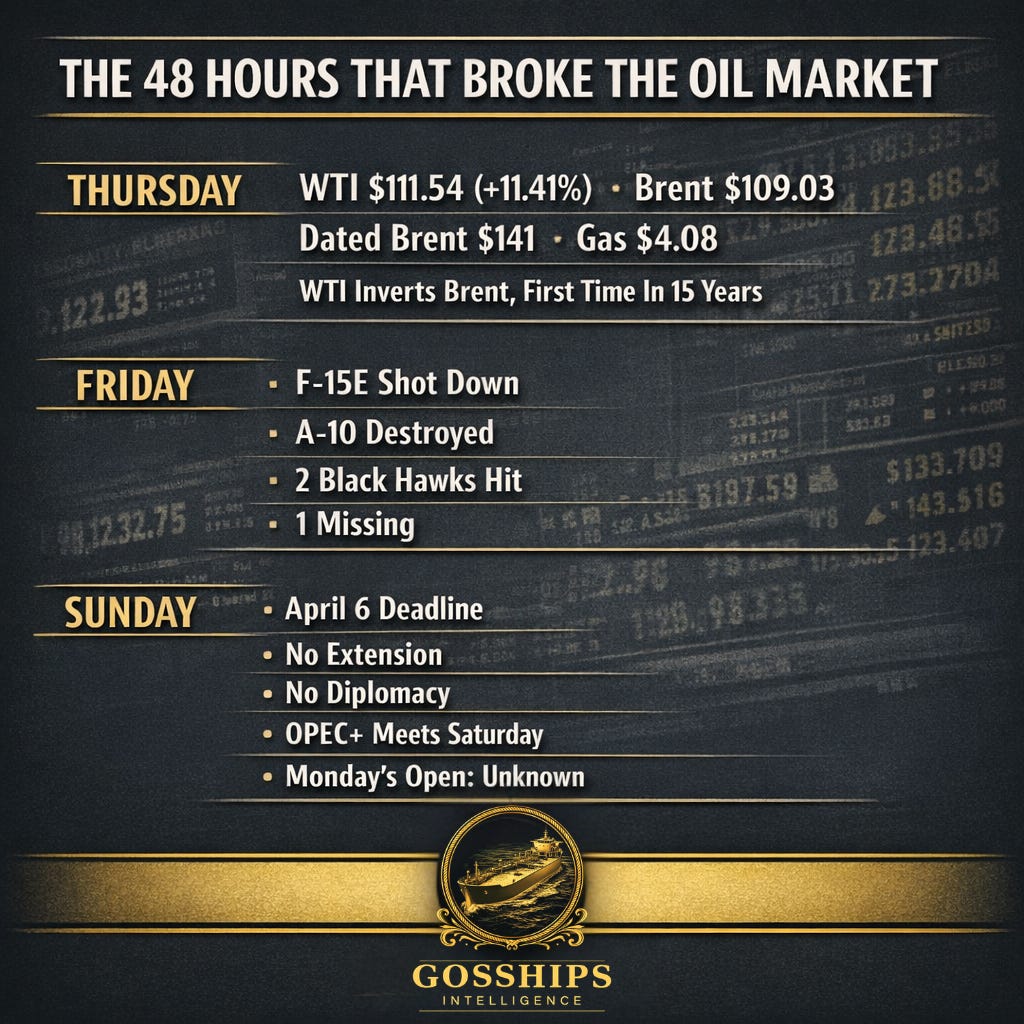
On Thursday, April 2, WTI crude settled at $111.54 per barrel, surging 11.41% in a single session, the highest level since June 2022, according to CNBC. Brent settled at $109.03. For the first time since before 2011, WTI traded above Brent, inverting a benchmark structure that has defined global oil pricing for 15 years, according to OilPrice.com and Rigzone. On Friday, April 3, Iran shot down a U.S. Air Force F-15E Strike Eagle over Iranian territory, the first manned American combat aircraft loss of the war, according to ABC News, NBC News, and CNN. One crew member was rescued by U.S. special forces inside Iran. The status of the second remains unknown. Markets were closed for Good Friday. Brent was indicated at approximately $112 in early electronic trading on April 3, according to Fortune. The F-15E shootdown occurred later that day with markets closed for Good Friday. The April 6 deadline for Iran to reopen the Strait of Hormuz arrives Sunday. OPEC+ meets Saturday. Nobody knows what oil prices do when markets reopen Monday morning.
📋 In this issue:
🛢️ The Story
📊 By The Numbers
🔍 Why It Matters
👀 What to Watch
🚨 Gosships Signal
📊 Get The Deep Water Report
→ Global Tanker Market Outlook Q2 2026
📋 Competency-Based Maritime Training
→ SwiftAction
📌 Gosships Data Card
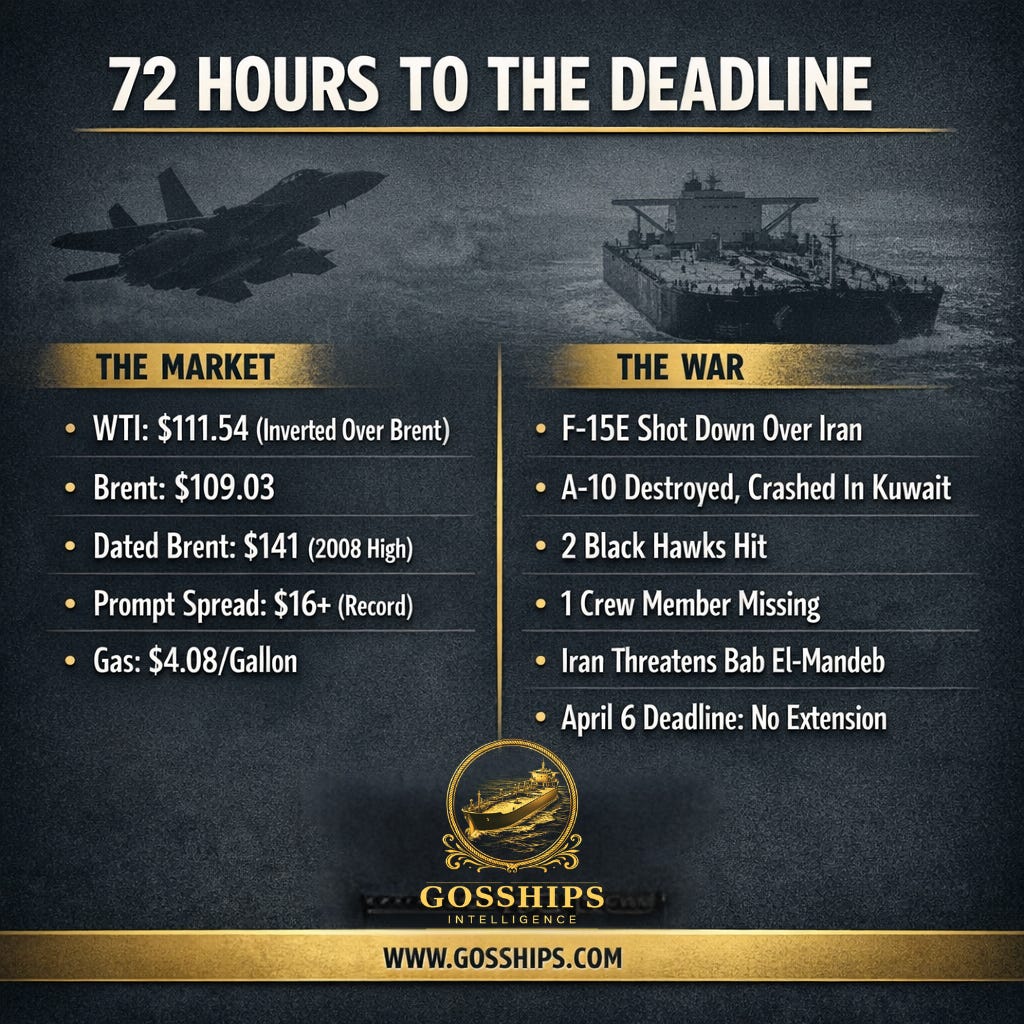
→ April 2: WTI Settles At $111.54, Surges 11.41%, Highest Since June 2022 (CNBC)
→ April 2: Brent Settles At $109.03. WTI Surpasses Brent For First Time In 15 Years (OilPrice.com, Rigzone)
→ April 2: WTI Prompt Spread Exceeds $16/Barrel, Widest On Record (Bloomberg Via Rigzone)
→ April 2: Dated Brent Spot Hits $141, Highest Since 2008 (S&P Global Via CNBC)
→ April 2: Gas Hits $4.08/Gallon, First Above $4 Since August 2022, Up $1.10 In Five Weeks (AAA)
→ April 3: F-15E Strike Eagle Shot Down Over Iran, First Manned US Combat Aircraft Loss (ABC News, NBC News, CNN)
→ April 3: A-10 Thunderbolt Struck By Iranian Fire, Crashes In Kuwait. Pilot Rescued. (NBC News, ABC News)
→ April 3: Two Black Hawk Helicopters Hit During Search And Rescue (NBC News)
→ April 3: Iran Parliament Speaker Threatens Bab El-Mandeb Strait (NBC News)
→ April 6: Trump Deadline For Hormuz. No Extension Announced.
🛢️ The Story
Three things happened in 48 hours that the oil market has never experienced simultaneously.
First, the benchmark structure broke. WTI crude has traded at a discount to Brent for as long as most traders have been in the market. Brent is the seaborne benchmark. It prices two-thirds of the world’s traded crude. WTI is the landlocked American benchmark, delivered to Cushing, Oklahoma. On Thursday, WTI settled at $111.54 per barrel while Brent settled at $109.03, according to CNBC. Art Hogan, chief market strategist at B. Riley Wealth, told Rigzone that WTI “is trading at a rare premium over Brent crude,” calling it “a reversal of the typical market structure where Brent usually trades several dollars higher.” The reason: “WTI is currently the primary vehicle for traders betting on the duration of U.S. involvement” in the Iran conflict, Hogan told Rigzone. Phil Flynn, senior market analyst at the PRICE Futures Group, told Rigzone the market saw “record backwardation in WTI.” Flynn noted part of the spread reflects technical factors, including WTI’s May contract trading against Brent’s already-rolled June contract and holiday-related position unwinding, according to Rigzone. But the structural driver, the market pricing accessible barrels over seaborne barrels, is real.
The numbers behind Thursday’s session were historic by multiple measures. WTI’s prompt spread, the difference between its two nearest contracts, exceeded $16 per barrel, the widest premium on record, according to Bloomberg via Rigzone. Dated Brent, the benchmark for physical oil transactions, surged to $141 per barrel, the highest since 2008, according to S&P Global via CNBC. CNBC reported the physical spot price was $32.33 higher than the Brent futures contract, a gap that reflects the extreme scarcity of actual barrels available for delivery. WTI crude has roughly doubled since the start of the year, according to Rigzone. BMI analysts, writing in a report sent to Rigzone by the Fitch Group, called Brent “primarily a paper market” that has been “cushioned by its geographic location and benchmark composition.”
The trigger for Thursday’s surge was Trump’s April 1 address to the nation. In a roughly 20-minute speech from the White House Cross Hall, Trump declared the war “nearing completion” within two to three weeks, vowed to hit Iran “extremely hard,” and stated the Strait of Hormuz would reopen “naturally” after the conflict ends, according to NPR, CNN, and CNBC. He offered no timeline for reopening the strait and no mention of negotiations. Hogan told Rigzone that the biggest driver of the April 2 surge was that Trump’s address “brought with it no line of sight to the opening of the Strait of Hormuz.” French President Emmanuel Macron said it would be “unrealistic to use military means to reopen the strait,” according to Bloomberg via Rigzone.
At the gas pump, AAA reported the national average at $4.08 per gallon on April 2, the first time above $4.00 since August 2022. The national average has risen $1.10 in five weeks from $2.98 on February 26, according to AAA. California reached $5.94 per gallon.
Second, the war escalated. On Friday, April 3, less than 48 hours after Trump told Americans that Iran has “no anti-aircraft equipment” and its “radar is 100% annihilated,” Iran shot down an F-15E Strike Eagle from the 494th Fighter Squadron based at RAF Lakenheath, UK, according to ABC News, NBC News, and CNN. One crew member was rescued by U.S. special forces inside Iranian territory. The status of the second crew member remains unknown, according to NBC News. A search and rescue operation is ongoing.
The F-15E was not the only aircraft hit. An A-10 Thunderbolt providing close air support for the rescue mission was struck by Iranian fire and crashed in Kuwait. The pilot ejected and was rescued, according to NBC News. Two UH-60 Black Hawk helicopters involved in the search and rescue were also struck by incoming fire. Crew members sustained injuries but both helicopters returned to base, according to NBC News. In total, Iran caused two U.S. military aircraft to crash and struck two more in a single day, according to ABC News.
NBC News reported that roughly half of Iran’s ballistic missile launchers remain intact and thousands of one-way attack drones remain in its arsenal, according to a U.S. official and a person briefed on the matter. Multiple missile stockpiles buried underground in Iran also remain undamaged. “Even at the rates at which they’re firing things now, they’re going to be able to sustain it for a while,” Kelly Grieco, senior fellow at the Stimson Center, told NBC News.
Third, Iran escalated its chokepoint threats. On Friday, Mohammad Bagher Ghalibaf, speaker of the Iranian parliament, posted on X: “What share of global oil, LNG, wheat, rice, and fertilizer shipments transits the Bab-el-Mandeb Strait?” He added: “Which countries and companies account for the highest transit volumes through the strait?” according to NBC News. The Bab el-Mandeb is the second critical energy chokepoint after Hormuz. Houthi forces aligned with Iran have attacked commercial shipping in the strait repeatedly since 2023. If Iran directs the Houthis to close the Bab el-Mandeb while Hormuz remains shut, the world loses access to both the Persian Gulf and the Red Sea simultaneously. Saudi Arabia’s Yanbu pipeline terminus, which Saudi Aramco CEO Amin Nasser said would reach maximum capacity of approximately 7 million barrels per day within days, sits on the Red Sea coast within Houthi missile range.
Related Coverage:
Goldman Sachs Just Called This “The Largest Supply Shock in the History of the Global Crude Market.”
Markets closed Friday for Good Friday. They do not reopen until Monday. The April 6 deadline arrives Sunday. OPEC+ meets Saturday. The F-15E crew member is still missing inside Iran. And no one in the oil market, the tanker market, or the White House has offered a concrete plan for what happens next.
What the convergence of a broken benchmark structure, a military escalation that contradicts the administration’s narrative, a parliamentary threat to close a second chokepoint, and a holiday weekend with the war’s most critical deadline means for tanker rates, gas prices, and every barrel of oil that has to move through a strait controlled by the country that just shot down an American fighter jet, is below.
📊 By The Numbers