


⚓ The Gosships Team
Gosships Intelligence Is Published At Gosships.com
For Sponsorship And Partnership Inquiries Contact intelligence@gosships.com
|⚓ About Us | 🛢️ Exclusive Report | 📋 SwiftAction Training |
🏅Black Gold Membership (*53 Slots Left)
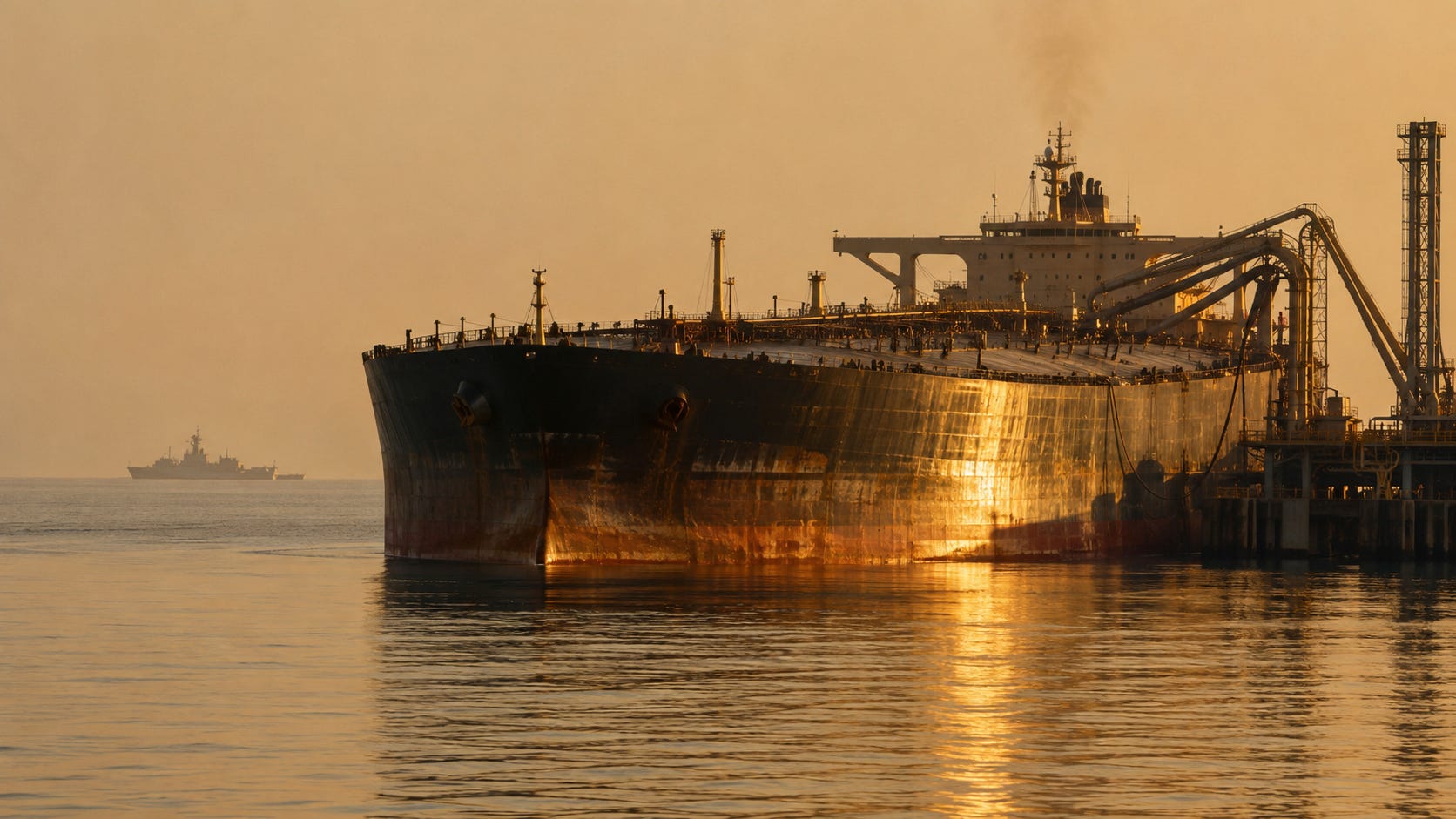
Every war produces winners, and this one has a long roster.
When President Trump reimposed a naval blockade on Iran and announced a 20 percent toll on Hormuz cargo on July 12, oil leapt more than 9 percent, and the money began flowing again to the players who cashed in when the war started in February: the United States, Russia, Saudi Arabia, the European oil majors, the trading houses, the tanker owners, and one shadow fleet that almost nobody names. The ceasefire is dead. The winners are back.
📋 In This Issue:
🛢️ The Story
📊 By The Numbers
🔍 Why It Matters
👀 What To Watch
🚨 Gosships Signal
🔔 Not Subscribed? Gosships Intelligence Delivers Oil Shipping Intelligence. Subscribe Here!
📊 Order Our Exclusive Report
→ Global Tanker Market Outlook Q3 2026 Edition
📋 Competency-Based Maritime Training
→ SwiftAction
Related Coverage


📌 Gosships Data Card
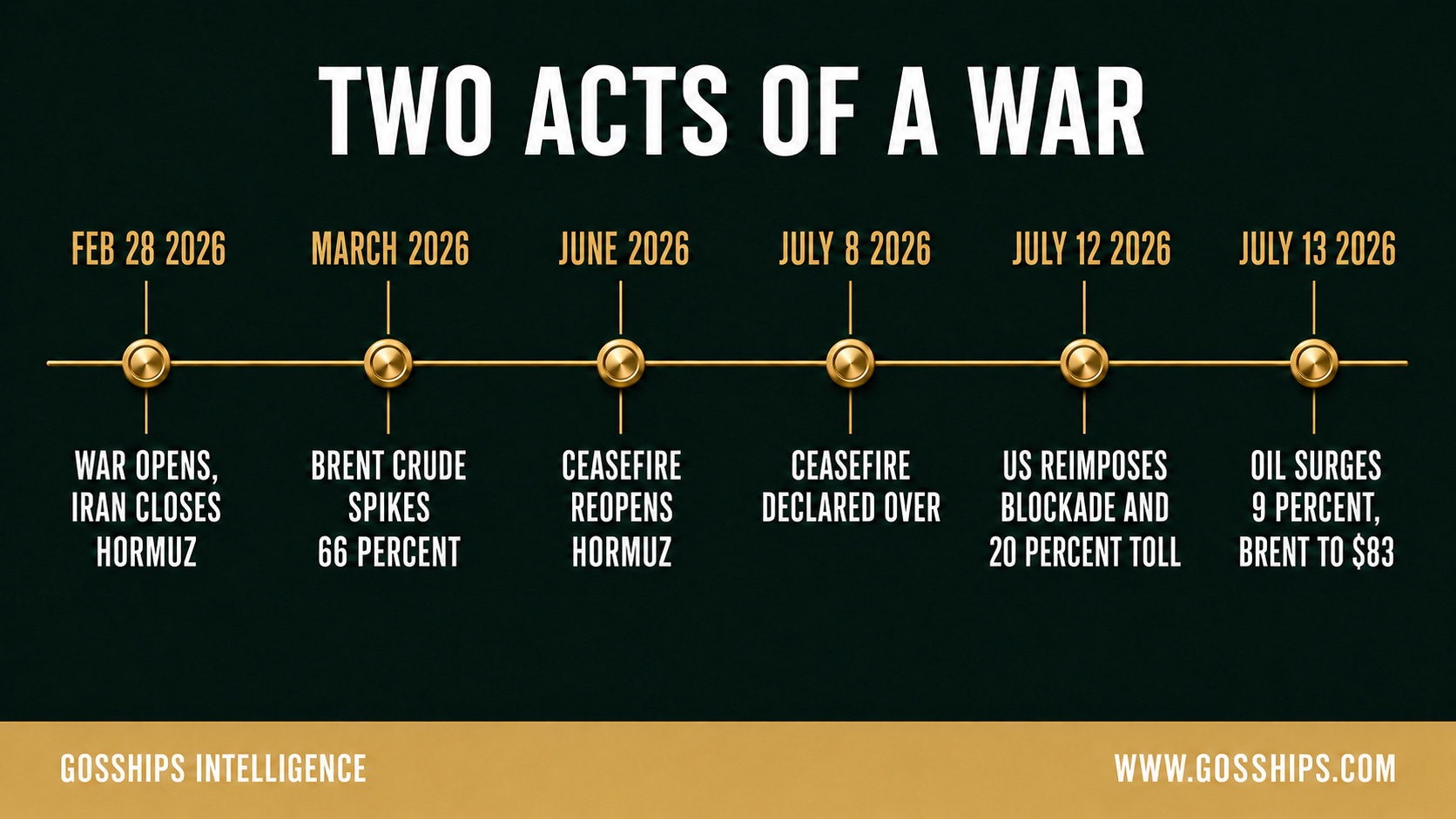
→ February 28, 2026: US and Israeli strikes kill Iran’s Supreme Leader and top officials; Iran closes the Strait of Hormuz
→ March 2026: Brent crude spikes 66 percent to a $94.65 peak as the chokepoint seizes up
→ June 2026: A US-Iran truce reopens Hormuz and floods tonnage back
→ July 8, 2026: President Trump declares the ceasefire over and strikes resume
→ July 12, 2026: The US reimposes its Iran blockade and announces a 20 percent toll on Hormuz cargo
→ July 13, 2026: Oil surges more than 9 percent, Brent settling at $83.30
Sources: US Central Command; White House; Al Jazeera; contemporaneous market reporting.
🛢️ The Story
Start with the number that reframes everything. When war erupted on February 28, US and Israeli strikes killed Iran’s Supreme Leader Ali Khamenei and a cluster of senior officials, and Iran closed the Strait of Hormuz. Brent crude jumped 66 percent, from a $57.10 close on February 27 to a $94.65 peak on March 7. A chokepoint that carries roughly a fifth of the world’s seaborne oil seized up, and every barrel that still moved became worth far more. War does not destroy oil wealth. It concentrates it, and hands it to whoever can still deliver.
The countries cashed in first. According to a June analysis by Al Jazeera, the United States booked roughly $50 billion in additional oil export revenue as buyers east of Suez scrambled for non-Gulf crude. Russia, whose exports kept flowing, stands to gain between $45 billion and $151 billion in extra budget revenue this year, the Kyiv School of Economics estimated, depending on how long the disruption lasts. Saudi Arabia leaned on its 1,200-kilometer East-West pipeline to the Red Sea to route around Hormuz, and Saudi Aramco’s first-quarter profit rose 25 percent to $32.5 billion as it sold into a spiking market. Three governments, tens of billions of dollars, all from a war meant to punish one of them.
The oil majors were next. BP's own first-quarter results showed underlying profit of $3.2 billion, more than double a year earlier on higher refining margins and strong oil trading, and the European majors with large trading arms did best of all, because volatility is what trading desks are built to harvest. In the United States, the refiners hit records: the benchmark 3-2-1 crack spread, the rough margin a refinery earns turning crude into gasoline and diesel, reached an all-time high of $64.58 a barrel on July 8, and ExxonMobil signaled a roughly $5 billion quarter-on-quarter profit jump, with analysts expecting its second-quarter earnings to roughly triple the first. Even a partial disruption to Middle East supply, which cost Exxon an estimated $1.2 billion in production, was dwarfed by the margin windfall it created downstream.
The trading houses did well out of the dislocation, though not uniformly. Trafigura reported surging profit and volumes in its first results after the Hormuz closure, and the trading arms of Shell and TotalEnergies pointed to gains tied to the war. Vitol, the largest independent trader, was the cautionary case: it told its banks it still made around $2 billion in the first quarter, but only after taking losses on Iran-war derivatives that forced it to reorganize its trading desk.
Then there is the business Gosships watches most closely, and where the war landed hardest and most profitably: the tankers. Shipping bottlenecks idled the equivalent of roughly 7 percent of the world’s tanker capacity, and freight rates blew out, from near 100 Worldscale points before the war to north of 500 at the peak. Frontline, controlled by John Fredriksen, posted a first-quarter net profit of $559.1 million, in its strongest quarter by adjusted earnings since 2004, and locked in second-quarter VLCC rates around $181,700 a day. Greece’s Okeanis Eco Tankers reported a record quarter and told investors the first half of 2026 could beat any full year in its history. DHT Holdings and other pure-play owners rode the same wave. For an owner willing to send a ship toward Hormuz, the war was the best market in a generation.
And then there is the winner almost nobody names. Moving sanctioned Iranian and Russian crude through a war zone is not a trade most owners will touch, which is precisely why it pays. According to the US Treasury, that business runs in large part through Mohammad Hossein Shamkhani, the son of Ali Shamkhani, the security chief killed on the war’s first day. His network moves Iranian and Russian crude in breach of sanctions through layers of shell companies, with Crios Shipping LLC as its maritime cornerstone, a UAE front called Meritron DMCC to acquire vessels, and a hedge fund, Ocean Leonid Investments, to turn the oil proceeds into investment returns. The mechanics are pure shadow trade: tankers running dark to ship-to-ship transfers off Malaysia, cargo papers reissued to erase the oil’s origin, delivery to China. Treasury has gone further and tied the network to a barter line in which Iran ships missile and drone parts to Russia and takes petroleum in return. In designating it, Treasury said Shamkhani “heads a multi-billion dollar Iranian and Russian petroleum sales empire that enriches a family connected to the highest echelons of the Iranian regime at the expense of the Iranian people.” The pressure campaign has hit the network twice, in its largest Iran action since 2018 in July 2025 and again under a campaign named Economic Fury on April 15, 2026, and it kept sailing.
The July 12 move is its own turning point, and not only for Iran. Trump said Iranian ships would be barred from Hormuz outright, while every other country could still transit if it paid a 20 percent toll on cargo, which he cast as reimbursement for the US “providing safety and security to this very volatile section of the World.” Central Command said the blockade would take effect on Tuesday, July 14. A direct American levy on the world’s most important oil artery, which carries roughly a fifth of seaborne crude, is without modern precedent, and it raises the landed cost of every Gulf barrel while handing the advantage to non-Gulf suppliers and the traders positioned to arbitrage the gap, the United States and its shale exporters chief among them. It will not go unchallenged. Within hours the International Maritime Organization rejected the idea, its secretary-general Arsenio Dominguez saying the body “stands firmly against charging fees for passage through straits used for international navigation.” Kpler already reports Hormuz crossings down more than half in a single week.
That is the uncomfortable arithmetic of the paradox at the center of this war. In March, Iran’s physical crude exports fell 45 percent, yet the value of the oil it shipped fell only 15 percent, because the war had made each barrel so much more valuable, according to tanker tracking by United Against Nuclear Iran. The regime the strikes were built to bankrupt lost throughput and kept the money, and the fleet that made that possible is the same one now positioned to profit from the second act. On July 12, the war came back with a vengeance. Who wins in this next round, why a US toll on Hormuz may reshuffle the roster, and the one force that could finally take the shadow fleet down, is below.
