


⚓ Gosships Intelligence
Gosships Intelligence Is Published At Gosships.com
For Sponsorship And Partnership Inquiries Contact intelligence@gosships.com
|⚓ About Us | 🛢️ Exclusive Report | 📋 SwiftAction Training |
🏅Black Gold Membership (*53 Slots Left)
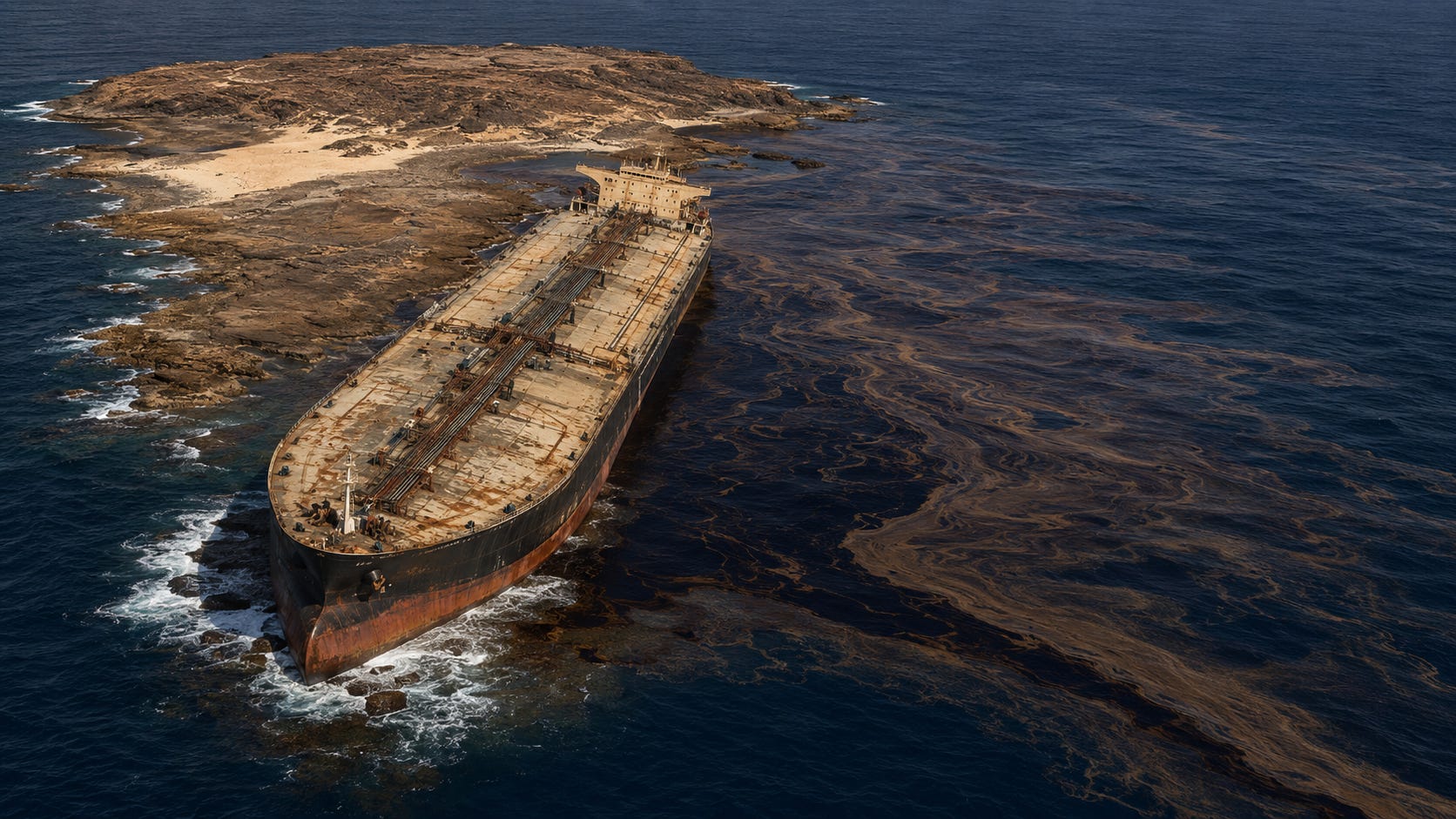
The fund that exists to pay when a shipowner walks away has told Reuters it will take no part in the clean-up after the Caroline Bezengi. Oman is a party to the 1992 Civil Liability Convention and to the 1992 Fund Convention, which together open a ceiling of 203 million special drawing rights for one incident, about $277 million at the International Monetary Fund's mid-August rate. The reason given is an act of war. There is a war in those waters. Nobody has connected it to this hull.
The casualty itself has been covered heavily and accurately. The Caroline Bezengi (IMO 9224439) is a Suezmax built in 2001, loaded with Russian Urals crude on the Black Sea. On June 8, off the Yemeni coast, her crew reported a suspected explosion and the vessel began to fail. Her people abandoned her on June 11 and her transponder went quiet the same day. On June 30 she grounded at Al Qibliyyah Island in Oman's Hallaniyat archipelago, inside a marine reserve. Ambrey began salvage on August 13 with more than 100 tonnes of equipment, vessels and aircraft.
What has not been set against it is the text of the two conventions Oman belongs to. Both are short. Both are public. Neither says what the coverage says.
The 1992 Fund Convention exists to pay when the shipowner does not. Article 4, paragraph 1 obliges the Fund to compensate anyone who cannot obtain full and adequate compensation under the Liability Convention, and the first reason it lists is “because no liability for the damage arises under the 1992 Liability Convention.” The Fund is the backstop for precisely the case where the owner walks away clean.
Article 4, paragraph 2 gives the Fund two ways out. The first is that the claimant cannot prove a vessel was involved. The second is that the Fund itself proves the damage “resulted from an act of war, hostilities, civil war or insurrection.”
That second door is the one being closed on Oman, and closing it requires the Fund to establish that the June 8 explosion was hostilities. Sixty-nine days on, as of August 16, no government has attributed it and no group has claimed it. The exclusion is doing work the evidence has not yet done.
📋 In This Issue:
⚖️ The Story:
The clause the Fund does not have, the war nobody has tied to this hull, and the ceiling Oman set for itself.
📊 By The Numbers:
The limits, the dates, the areas and the attributions, figure by figure.
🔍 Why It Matters:
Why the underwriter, the coastal state and the claims lawyer read the same two paragraphs three different ways.
👀 What To Watch:
The two clocks nobody has started, and the announcement that would prove this brief wrong.
🚨 Gosships Signal:
What it means when a compensation system built for tanker spills meets a tanker spill and does not open.
📊 Order Our Exclusive Report
→ Global Tanker Market Outlook Q3 2026 Edition
📋 Competency-Based Maritime Training
→ SwiftAction
🔗 Related Coverage


📌 Gosships Data Card
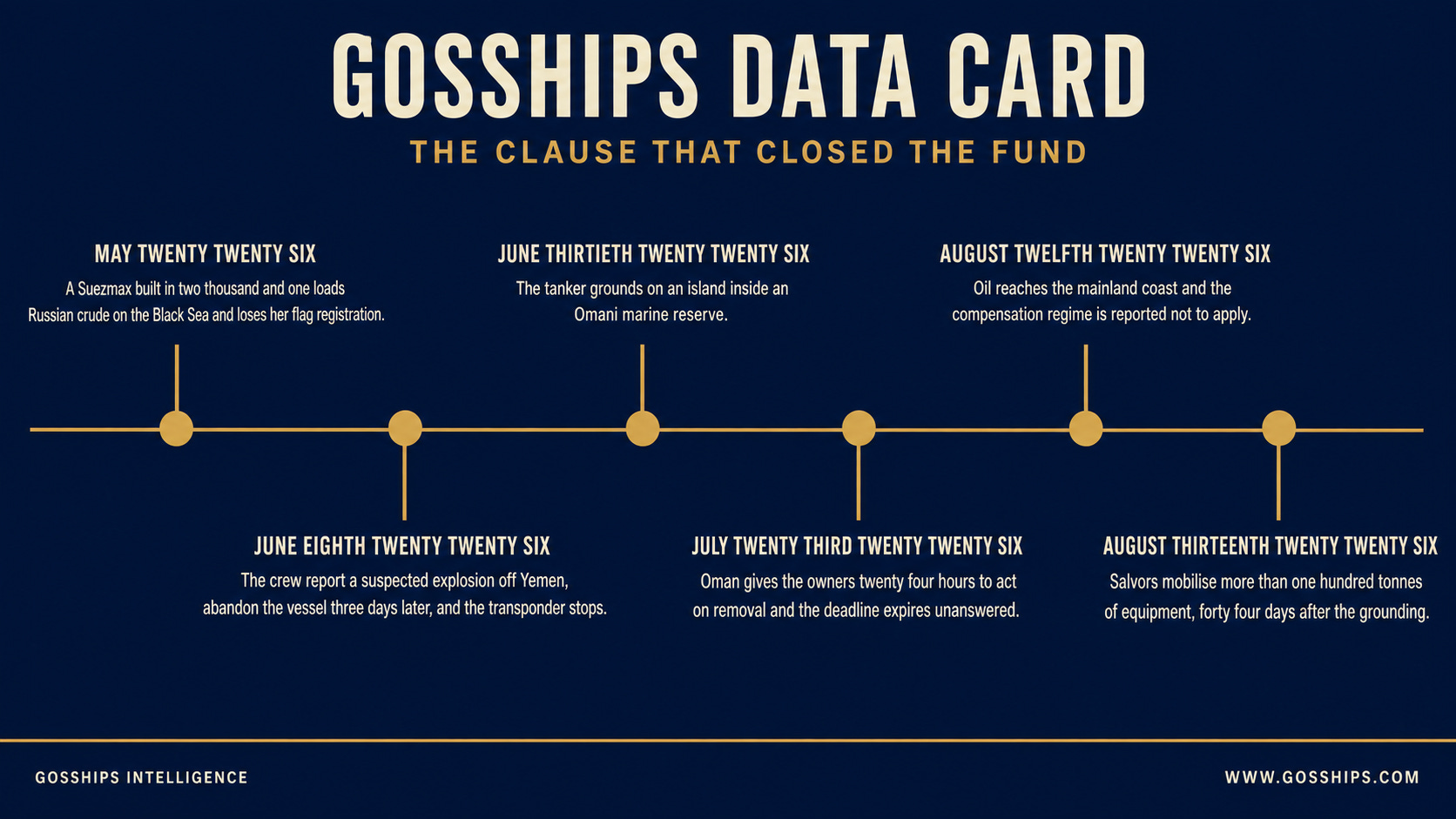
May 2026: The Caroline Bezengi, a Suezmax built in 2001, is reported to have loaded Russian Urals crude at Novorossiysk on May 11 and to have been bound for Sikka in Gujarat. Reuters gives a different window, putting her departure from Russia in April and her Suez transit at the end of May. Greenpeace says Cameroon’s registry deleted her on May 29 and that the International Maritime Organization now lists her flag as unknown, while Insurance Business dates the deletion to June (The Week, July 24, 2026; TechTimes, August 1, 2026; Reuters, August 11, 2026; Greenpeace International, August 5, 2026; Insurance Business, August 11, 2026).
June 8, 2026: The crew report a suspected explosion off Yemen. They abandon the vessel on June 11 and her transponder transmits for the last time the same day. No government has attributed the blast and no group has claimed it (gCaptain, August 13, 2026; TechTimes, August 1, 2026; The Associated Press, August 12, 2026).
June 30, 2026: The tanker grounds at Al Qibliyyah Island in the Hallaniyat archipelago off Dhofar, inside a marine reserve. She is carrying an estimated 800,000 barrels, a figure Reuters put at nearly one million barrels in a separate report, and no cargo tonnage has been published (Reuters, August 11 and 12, 2026; gCaptain, August 13, 2026).
July 23, 2026: Oman's Ministry of Transport, Communications and Information Technology gives the owners 24 hours to act on removal. The notice is addressed to Rentoor Shipmanagement of Huangpu Qu, Shanghai, the registered owner. Vessel databases give Villar Shipmanagement as operator. The deadline expires the following day with no response. Omani maritime authorities boarded her on July 12 and, per The Maritime Executive, found her settling lower with her list increasing and crude leaking into the ballast spaces, every tank apparently breached but the single empty one. The same outlet reported on August 13 that there had still been no catastrophic failure and no apparent major breach of the cargo tanks (The Maritime Executive, July 23 and August 13, 2026; The Week, July 24, 2026; TechTimes, August 1, 2026).
August 12, 2026: Oil reaches the mainland at Ras Madrakah. Reuters reports the same day that the International Oil Pollution Compensation Funds told it they would take no part in clean-up costs, because they were treating the casualty as an act of war (The Associated Press, August 12, 2026; Reuters, August 12, 2026).
August 13 to 15, 2026: Ambrey mobilises more than 100 tonnes of equipment, salvage vessels and aircraft, 44 days after the grounding and 66 days after the explosion. Two days later Oman’s Environment Authority reports 12 kilometres of coast affected at Ras Madrakah, no pollution on Masirah Island, and water samples at Ras Madrakah and Duqm within approved standards (gCaptain, August 13, 2026; Ambrey statement, August 13, 2026; Oman Environment Authority via Muscat Daily and Times of Oman, August 15, 2026).
Sources: International Oil Pollution Compensation Funds, Texts of the Conventions, 1992 Civil Liability Convention Articles I, III and V, 1992 Fund Convention Articles 3, 4, 6, 7, 10 and 14, and Supplementary Fund Protocol Article 4; International Oil Pollution Compensation Funds, States Parties list and incident map; International Oil Pollution Compensation Funds document IOPC/NOV24/4/4, The Potential Impact of Sanctions on the International Liability and Compensation Regime, September 27, 2024; International Monetary Fund SDR valuation, August 14, 2026; Council Implementing Regulation (EU) 2023/2875, Annex entry 270, December 18, 2023, and the consolidated Annex to Regulation (EU) No 269/2014 in force; Office of Foreign Assets Control designation, January 10, 2025; International Maritime Organization, Status of IMO Treaties; Reuters, August 11 and August 12, 2026; The Associated Press, August 4 and August 12, 2026; gCaptain, August 13 and August 14, 2026; Ambrey statement, August 13, 2026; The Maritime Executive, July 23, August 9 and August 13, 2026; Greenpeace International press release, August 5, 2026; Insurance Business, August 11 and August 13, 2026; TechTimes, August 1 and August 10, 2026; MarineLink, August 12, 2026; The Week, July 24, 2026; energynews.pro, August 13, 2026; Al Jazeera, August 13 and August 14, 2026; Muscat Daily and Times of Oman, August 15, 2026.
⚖️ The Story
What The Fund Is For
Start with what the money is. The 1992 Fund is not an insurance policy and it is not aid. Article 10 requires annual contributions from anyone receiving more than 150,000 tons of contributing oil by sea into a Member State, so the fund behind a tanker spill in Oman is financed by refiners and importers and, eventually, by everyone buying the products. The money is already collected. The only question is whether it moves.
It moves under Article 4, paragraph 1, which obliges the Fund to compensate anyone “unable to obtain full and adequate compensation for the damage under the terms of the 1992 Liability Convention.” The first reason listed is “because no liability for the damage arises under the 1992 Liability Convention.”
Read that against the shipowner’s position and the architecture becomes obvious. Article III, paragraph 2 releases the owner in three defined cases: damage that “resulted from an act of war, hostilities, civil war, insurrection or a natural phenomenon of an exceptional, inevitable and irresistible character”; damage “wholly caused by an act or omission done with intent to cause damage by a third party”; and negligence by an authority responsible for navigational aids.
A limpet mine placed by persons unknown is on its face the second of those, and on the plain words it releases the owner. The clause demands the damage be wholly caused by that third party, and 22 days between blast and grounding, 19 of them with nobody aboard, is the obvious counter-argument. That outcome is exactly what Article 4, paragraph 1(a) of the Fund Convention was drafted to catch.
