


⚓ The Gosships Team
Gosships Intelligence Is Published At Gosships.com
For Sponsorship And Partnership Inquiries Contact intelligence@gosships.com
|⚓ About Us | 🛢️ Exclusive Report | 📋 SwiftAction Training |
🏅Black Gold Membership (*53 Slots Left)
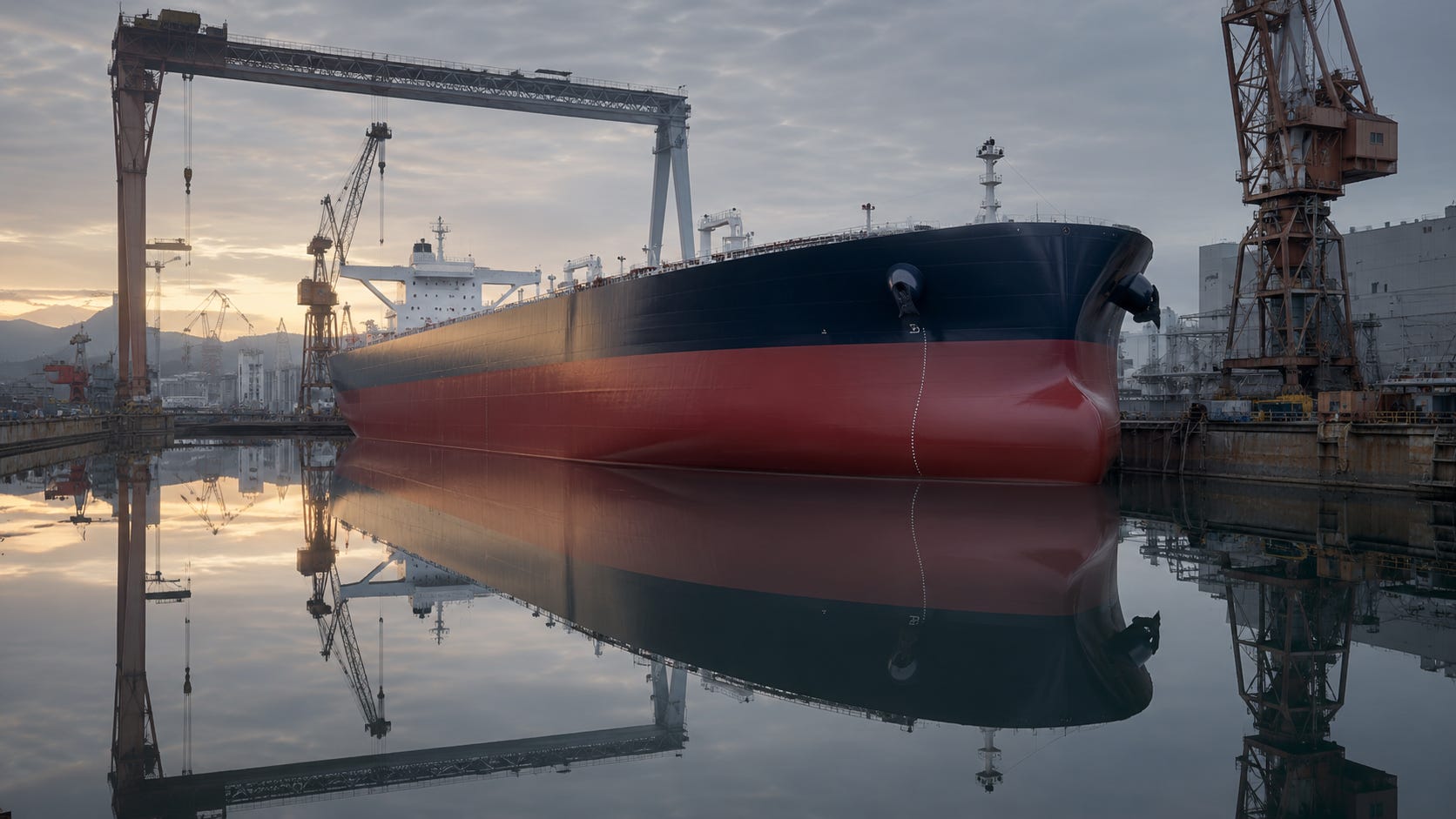
One of the largest banks on Wall Street has spent the past six months ordering oil tankers, and this week it confirmed it is not finished. On July 8, JPMorgan confirmed to TradeWinds that its shipowning arm now has seven Suezmax crude tankers on order at Samsung Heavy Industries. The orders run through Global Meridian Holdings, a Bermuda-based platform inside JPMorgan Asset Management that has quietly owned ships for years. The bank is not dabbling. Industry sources cited by Splash247 estimate JPMorgan-linked platforms have committed more than $3 billion to newbuildings in roughly six months, and the timing is the story: the smartest money in the room is buying crude tankers at the single busiest ordering moment the sector has ever recorded.
📋 In This Issue:
🛢️ The Story
📊 By The Numbers
🔍 Why It Matters
👀 What To Watch
🚨 Gosships Signal
🔔 Not Subscribed? Gosships Intelligence Delivers Oil Shipping Intelligence. Subscribe Here!
📊 Order Our Exclusive Report
→ Global Tanker Market Outlook Q3 2026 Edition
📋 Competency-Based Maritime Training
→ SwiftAction
📌 Gosships Data Card
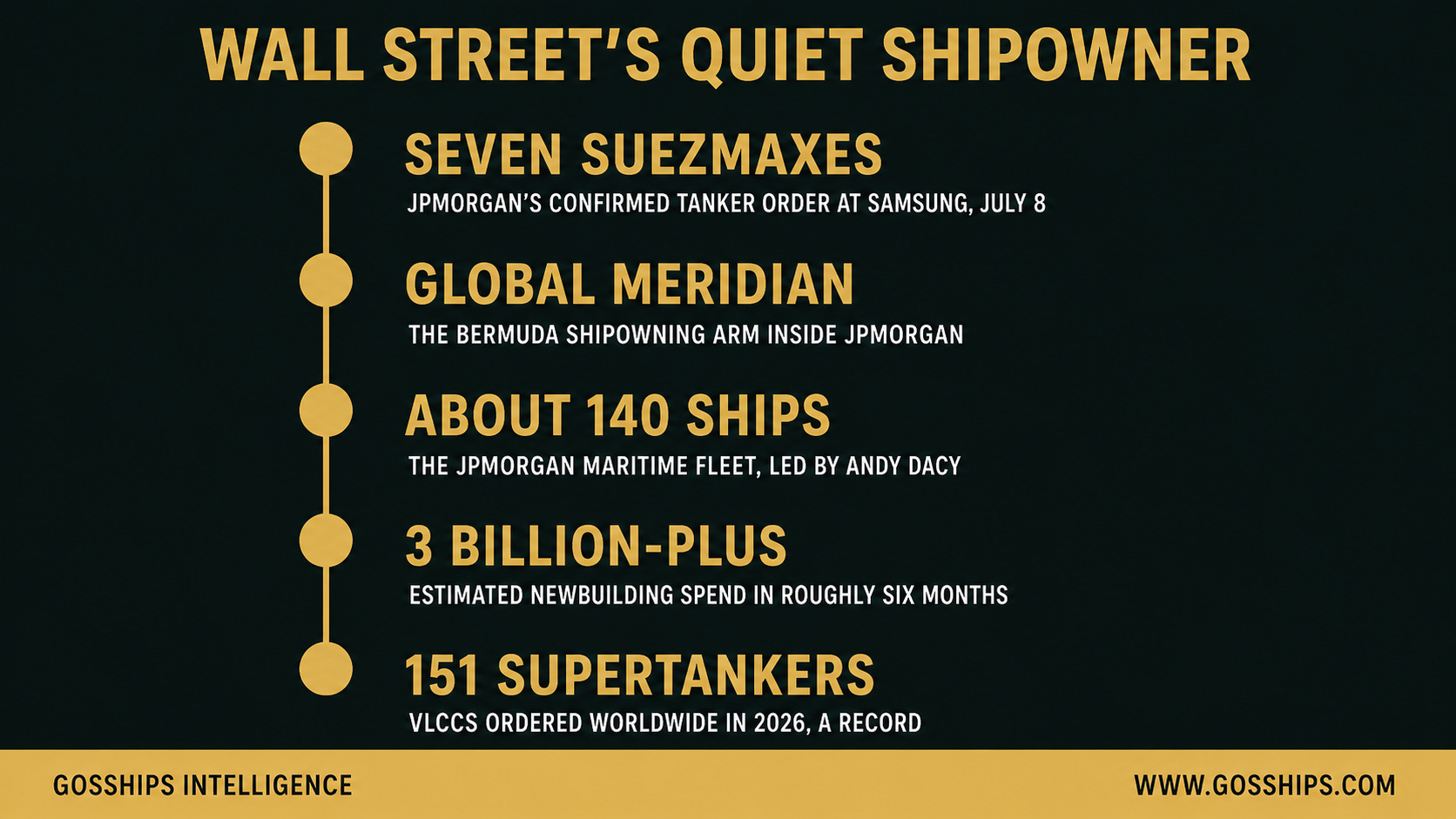
➡️ Seven Suezmaxes JPMorgan’s confirmed crude tanker order at Samsung Heavy, as of July 8
➡️ Global Meridian the Bermuda shipowning arm inside JPMorgan Asset Management placing the orders
➡️ About 140 ships the JPMorgan maritime fleet, run by Andy Dacy, per TradeWinds
➡️ $3 billion-plus estimated JPMorgan newbuilding spend in roughly six months, per Splash247
➡️ 151 VLCCs crude supertankers ordered worldwide in 2026 so far, a record, per BIMCO
Sources: TradeWinds; Splash247; Riviera; BIMCO; iMarine; VesselsValue. Reporting to July 2026.
🛢️ The Story
Most people picture JPMorgan as a bank: deposits, deals, trading desks in glass towers. Very few picture it as a shipowner. Yet for years the bank has quietly operated a substantial fleet of ocean-going ships on behalf of institutional investors, and over the past six months it has been buying crude tankers with the conviction of an investor that thinks it knows where the market is going. On July 8, that quiet accumulation became a confirmed number. JPMorgan told TradeWinds it now holds seven Suezmax crude tankers on order at South Korea’s Samsung Heavy Industries.
The vehicle behind the orders is Global Meridian Holdings, a Bermuda-based shipowning platform that sits inside JPMorgan Asset Management. According to TradeWinds, the operation is run day to day by Andy Dacy, who the publication says manages the bank’s roughly 140-vessel fleet “with the intensity of a shipowner not just a banker.” That fleet is not a paper position. It spans crude and product tankers, bulk carriers, LNG carriers and other vessels, and VesselsValue data cited in mid-2025 put Global Meridian’s tanker holdings alone at around 28 ships before this year’s ordering wave. This is a genuine industrial fleet owned by an asset manager, not a financing line on a balance sheet.
The recent buying has been steady rather than splashy, which is exactly why it has stayed under the radar. Splash247 and Riviera have tracked Global Meridian and JPMorgan-linked entities placing repeated orders at Samsung through the spring and early summer, first a batch in March, more in June, and the two additional 158,000 deadweight tonne Suezmaxes confirmed on July 8, each priced by TradeWinds at about $92 million and scheduled for delivery in the first quarter of 2028. Beyond the Suezmaxes, JPMorgan-linked platforms have also been tied to LNG carriers and very large gas carriers at the same yard. Riviera reported that one recent run of gas carrier orders alone pushed the associated investment toward $1 billion. Pulling the threads together, industry sources cited by Splash247 estimate that JPMorgan-linked platforms have committed more than $3 billion to newbuilding projects over roughly the past six months. That figure is an estimate, not a filing, and it spans tankers, LNG and LPG carriers rather than tankers alone, but the direction is unmistakable.
The order flow has been large enough to move a shipyard’s entire year. On July 8, the same day JPMorgan confirmed its seventh Suezmax, iMarine reported that the tanker deal helped push Samsung Heavy Industries past $10 billion in annual order intake, the first time the yard has crossed that threshold since 2021. When a single asset manager’s tanker program is a meaningful line item in a major shipbuilder’s record year, the “quiet” part of the story stops being an accident and starts being a strategy.
To understand why a bank owns ships at all, it helps to know what Global Meridian actually is. It is the shipowning face of JPMorgan Asset Management’s global transportation group, the long-running platform Andy Dacy leads, which invests institutional client capital in vessels through its Global Maritime Investment Fund. Crucially, this is not the bank wagering its own balance sheet. It is an asset manager deploying clients’ money into ships the way other funds deploy into real estate or infrastructure: as hard, cash-generating assets to be bought near the bottom of a cycle, chartered out for yield, and sold near the top for a capital gain. The evidence that this is a cycle play, not a permanent fleet, is in its own trading record. Splash247 reported that Global Meridian recently offloaded two 49,999 dwt medium-range product tankers, the Clearocean Mary and Clearocean Maria, for roughly $30 million each, vessels it had bought in 2019 for about $27 million apiece. It has also been linked by Splash247 to sale-and-leaseback deals with the Norwegian owner Ocean Yield, a structure that lets it control tonnage while moving the financing off its own books. Buy, charter, lease back, sell into strength: this is portfolio management applied to steel.
That history is what makes the current buying spree so interesting, and so worth a professional’s attention. Global Meridian is not a naive entrant chasing a hot market. It is a disciplined, cycle-aware investor with a track record of timing its entries and exits. And right now it is pouring money into crude tankers at the most crowded ordering moment the sector has ever seen. According to BIMCO, crude tanker newbuilding contracting reached about 60 million deadweight tonnes across 234 ships in 2026, the strongest year for crude tanker orders on record, led by 151 very large crude carriers ordered so far, more than double the total for all of 2025. Splash247 has reported the same record surge and the alarm it is raising about a looming supply glut later in the decade.
So the market is left with two readings of the same fact, and they cannot both be right. The bullish reading is that JPMorgan’s asset managers, who have made money buying ships before, see a structural case for large crude tankers: an aging global fleet that must be replaced, longer voyage distances as sanctioned and rerouted barrels travel farther, and a Strait of Hormuz crisis that has rewarded owners willing to carry crude through risk. In this reading, the smart money is positioning early for years of firm demand, and its 2028 deliveries are timed to arrive as older tonnage retires. The bearish reading is that even the disciplined money can be swept up in a crowd, and that 234 crude tankers hitting the water in the coming years, JPMorgan’s among them, is precisely how a record order book becomes a glut that craters the rates those ships were bought to earn.
What is not in dispute is that a name most readers associate with mortgages and market-making has become a serious, active owner of the vessels that carry the world’s oil. The question that follows is the one that should make every broker, owner and financier sit up: when JPMorgan’s ship investors are buying crude tankers this aggressively, is that a signal to follow them in, or a warning that the top is near? The answer determines whether the next three years belong to the owners who ordered or the ones who waited. The full breakdown of who this squeezes, what it does to asset values and rates, and the specific signals that will show whether the bank called the cycle right, is below.
