


⚓ The Gosships Team
Gosships Intelligence Is Published At Gosships.com
For Sponsorship And Partnership Inquiries Contact intelligence@gosships.com
|⚓ About Us | 🛢️ Exclusive Report | 📋 SwiftAction Training |
🏅Black Gold Membership (*53 Slots Left)
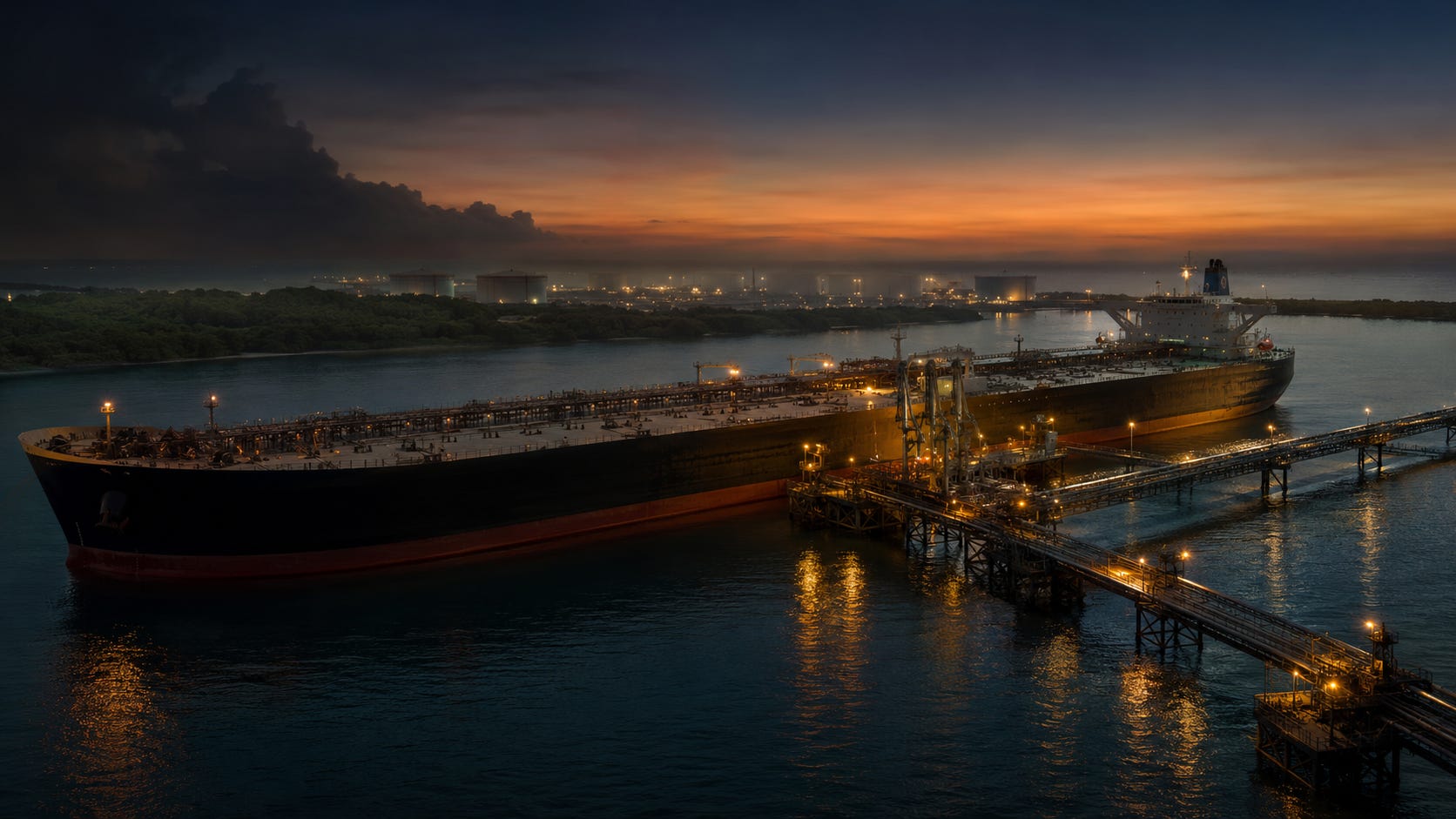
Oil traders move barrels. They do not usually move in.
This week, Reuters reported that Vitol, the largest independent energy trader on earth, is preparing to open an office in Caracas, staffed initially by about a dozen people in mainly trading roles and led by Mario Pantoja, a 35-year Chevron veteran who most recently headed the major's crude marketing across Venezuela. That is a small headcount with an enormous signal attached. The trading houses that have spent 2026 moving the bulk of Venezuela's exported oil to market are no longer content to lift the cargoes from a distance. They are building a permanent presence inside the country, hiring the people who used to run it for the majors, and positioning to become the operators of a petrostate the United States is trying to rebuild from the ground up.
📋 In This Issue:
🛢️ The Story
📊 By The Numbers
🔍 Why It Matters
👀 What To Watch
🚨 Gosships Signal
🔔 Not Subscribed? Gosships Intelligence Delivers Oil Shipping Intelligence. Subscribe Here!
📊 Order Our Exclusive Report
→ Global Tanker Market Outlook Q3 2026 Edition
📋 Competency-Based Maritime Training
→ SwiftAction
📌 Gosships Data Card
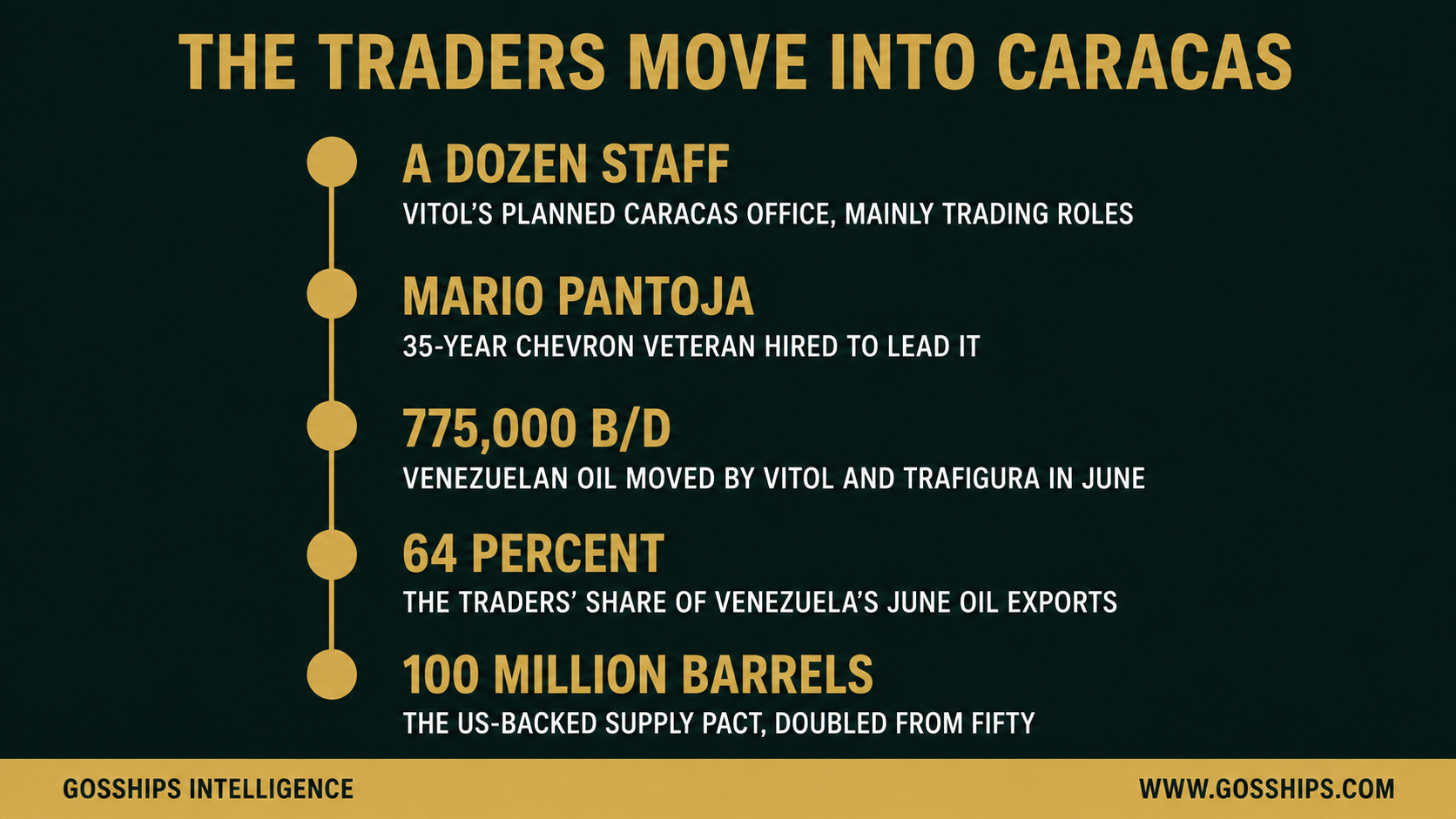
➡️ A dozen staff the size of Vitol’s planned Caracas office, mainly trading roles
➡️ Mario Pantoja the 35-year Chevron veteran hired to lead it, ex-head of Chevron’s Venezuela oil marketing
➡️ 775,000 b/d Venezuelan oil moved by Vitol and Trafigura in June
➡️ 64 percent the traders’ share of Venezuela’s 1.2 million b/d June exports
➡️ 100 million barrels the US-backed Vitol and Trafigura supply pact, doubled from fifty
Sources: Reuters; voz.us; US Treasury (OFAC); June export data cited in market reporting. Reporting to July 2026.
🛢️ The Story
For a commodity trader, an office is a commitment. A desk can lift cargoes from anywhere. Trading houses run the physical oil trade from Geneva, Houston and Singapore precisely because they do not need to be in the countries whose barrels they move. So when Vitol, the world’s largest independent energy trader, prepares to open a physical office in a country as sanctioned, as unstable and as politically radioactive as Venezuela, the news is not the office. It is what the office means.
Reuters reported this week that Vitol is making early preparations to open a Caracas office, offering jobs initially to about a dozen people in mainly trading roles. The unit is expected to be led by Mario Pantoja, who spent 35 years at Chevron and most recently ran the American major's crude marketing operation inside Venezuela. That detail is the story within the story. Vitol is not sending in outsiders to learn the market. It is hiring the man who ran the market for Chevron, the one company that never left, and setting him up to compete with his former employer for the barrels of a national oil company the United States is trying to resurrect. "For many years Vitol has had a strong relationship with PDVSA," Henry Medina, the trader's head of Latin America, told Reuters in an email. "We look forward to building on this and developing additional partnerships in Venezuela, as well as a meaningful presence in the country."
To understand why a trader would plant a flag in Caracas, follow the barrels. Under a framework agreed between Caracas and Washington and run under the Trump administration's authority, Vitol, Trafigura and a handful of other trading firms have spent 2026 carrying most of Venezuela's exported oil, steering crude that once sailed to Chinese refiners toward American, European and Caribbean buyers instead. The scale is no longer marginal. In June, Venezuela exported about 1.2 million barrels a day of crude and fuel, down slightly from 1.24 million in May. Of that, Vitol and Trafigura moved roughly 775,000 barrels a day, close to 64 percent of the total, while Chevron, the incumbent major, shipped about 293,000 barrels a day. The traders are not a supporting act in Venezuela’s oil comeback. They are the main channel through which it reaches the world.
That channel was opened by a deal. In January 2026, days after the United States removed Nicolas Maduro from power, the Trump administration reached an arrangement with Vitol and Trafigura to sell up to 50 million barrels of Venezuelan crude, a package valued at roughly $2 billion. The trading firms secured the first US licenses to load and export the oil in early January, and the traders later grew that volume past 100 million barrels. The same week, at a White House meeting with senior executives of Exxon Mobil, ConocoPhillips, Chevron, Halliburton, Valero and Marathon, Trump pledged that oil companies would put at least $100 billion into reviving Venezuela's energy industry under American military protection. The pitch was blunt: America would provide the security, and the companies would make their returns.
Here is the part that matters for anyone reading a headline that says the country is open for business. It is not, or not fully. Venezuela’s sanctions remain in place. The prohibitions on dealing with the government, with the state oil company PDVSA, with the state minerals firm and with the broader oil and gas sector are still law. What has changed is that Washington is now issuing licenses and waivers that authorize specific players, Chevron first, then Vitol and Trafigura, to lift and sell specific volumes, while a naval blockade that the United States imposed in December 2025 continues to control the surrounding waters. The reopening is not a lifting of sanctions. It is a licensed, policed, tightly controlled reopening, and the line between the barrels that are allowed to move and the barrels that are not is drawn in Washington. As recently as July 2026, the US Treasury’s Office of Foreign Assets Control sanctioned four more companies operating in Venezuela’s oil sector and named four tankers as blocked property. The door is open for the licensed. It is still being slammed on everyone else.
That two-track system is precisely why an office in Caracas is worth twelve salaries to Vitol. In a market where access is granted rather than bought, physical presence is leverage. A trader with people on the ground, relationships inside PDVSA, and a former Chevron marketing chief steering the desk is better placed to win allocations, structure deals, and move first when the next license is written. Trafigura is already inside the country, and Vitol is following it in. The competition is no longer just for cargoes. It is for position in a rebuild that Washington has priced at $100 billion, and the traders have decided that the way to win that position is to stop commuting and start living there.
The shipping consequences run straight through this. Venezuela’s oil map is being redrawn by policy, and every redrawing is a change in ton-miles. For years, the bulk of Venezuela’s heavy crude sailed the long haul to China, feeding the independent refiners that bought sanctioned barrels at deep discounts. Under the US-backed framework, those same barrels are being turned toward the United States, Europe and the Caribbean. In June, shipments to the United States rose to about 630,000 barrels a day, while flows to India, another discount buyer, fell to roughly 277,000. A barrel that once crossed the Pacific to Shandong now makes a far shorter trip to the US Gulf, which is fewer ton-miles per barrel even as total volume climbs. For the tanker market, the Venezuela reopening is a volume story and a routing story at the same time, and the two pull in opposite directions on vessel demand.
There is also a discount worth watching, because it is where the money is made and lost. When the licensed trade began, Venezuelan crude was moving at around $30 a barrel below the Brent benchmark. As the framework matured and buyers competed, that discount narrowed toward $15, with Brent near $63, meaning Venezuela was receiving roughly $48 a barrel rather than the $33 it collected under the deepest sanctions. Every dollar the discount narrows is a dollar that shifts from the trader’s margin and the refiner’s bargain toward the Venezuelan state and its American-backed reconstruction. A trader with an office in Caracas is positioned on the right side of that shift, close to the barrels, close to the counterparty, and close to the licenses that decide who gets to lift them.
None of this erases the risk, and the honest version of the story keeps it in view. Venezuela’s production recovery is real but fragile, its export terminals saw minor delays from two earthquakes in June, and the entire framework rests on a political settlement that is months old and could reverse. A trading house opening an office is a bet that the reopening holds, that the licenses keep coming, and that being physically present when Venezuela’s output climbs will pay off. It is a calculated, cycle-aware bet by firms that make their living reading exactly these situations. But it is a bet, and the same Washington that wrote the licenses can rescind them.
What is not in doubt is the shift in who controls the barrels. For a century, the story of an oil nation’s revival was written by the majors: the Exxons and Chevrons that drilled the fields, built the terminals and marketed the crude. In Venezuela, in 2026, that story is being co-written by the traders, and increasingly led by them. Vitol and Trafigura already move nearly two-thirds of the country’s oil. Now Vitol is hiring the majors’ own people and opening its own office to run the trade from the inside. The question that hangs over the whole reopening, and the one that should concern every major, every charterer and every sanctions officer watching this unfold, is below: if the trading houses are not waiting for the oil majors to rebuild Venezuela, and are instead building their own position inside it, who actually ends up controlling the largest proven oil reserves in the world?


